
HISTORIC MURDER: Oscar and Ruby Kempe were stabbed to death in Theodosia 58 years ago Aug. 17

Kathryn Ledbetter, who has written this article, remembers frequently visiting the Kempe home with her grandparents Opal and Rayford Ledbetter, pictured above, who lived at the bottom of the mountain from the Kempes on P Highway.
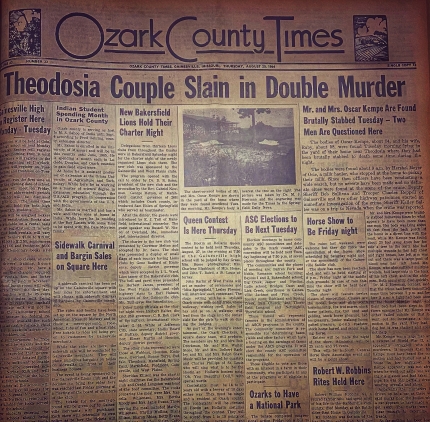
The murders of Oscar and Ruby Kempe were first published in the Ozark County Times on Aug. 20, 1964. The mysterious and brutal crime - and lack of a suspect - left many in Ozark County uneasy with many residents locking their doors for the first time ever. Ruby and Oscar Kempe moved to Theodosia from Chicago in 1955 after Oscar retired from working as a lithographer for the Chicago Tribune. They attended Theodosia United Methodist Church and became active on church committees. They seemed to be well-liked by their neighbors and friends.

The Kempes lived in this rock home on a 440-acre farm on top of Holt Bald, adjacent to the Lutie Lookout Tower.

This grainy photo of the sheet-covered bodies of the Kempes was taken by Ozark County Coroner M. H. Hoerman and was printed in the Ozark County Times on Aug. 20, 1964 and the Springfield Daily News on Aug. 19, 1964.

Kathryn Ledbetter visited the home about 15 years ago and took this photo in the yard of the home where the Kempes lived and were found dead in 1964. She remarks that the bare spot shown is very near where Ruby Kempe’s body was found on Aug. 18, 1964, and another bare spot was located where Oscar’s body was found. She wonders if grass has ever grown in those spots since the murders.
As residents await decision in Leckie murder trial, many are reminded of another brutal Ozark County murder
Editor’s note: Springfield-area freelance writer and retired Texas State University professor Kathryn “Kitty” Ledbetter wrote this two-part piece detailing the Aug. 17, 1964 brutal double murder of Oscar and Ruby Kempe in Theodosia. Ledbetter and her grandparents had become fast friends with the Kempes after they moved to Ozark County in 1955. “Many will remember the murders as the event that caused people to lock their doors for the first time and purchase utility lights for their yards. It occurred on P Highway near the Lutie Lookout Tower, a few hundred yards up the hill from the home of my grandparents, Rayford and Opal Ledbetter. My grandfather was on the scene and covered the bodies with sheets from the house. He served at the coroner's inquest,” she explained. Ledbetter says she has relatives on both sides of her family tree who originated in the Wasola and Theodosia/Lutie areas.
Every night my grandmother Opal Ledbetter sat close to her 19-inch black and white television screen to keep track of assassinations, wars, riots, murders and political intrigues reported on the evening news during the 1960s.
She would warn me that the world was a “mean old place” and urge me to be grateful for living in the Ozarks where it was safe. She didn’t lock her doors and never heard of anyone leaving lights on all night.
The world might be a mean place, but things like riots and wars never happened in Theodosia, 17 miles west of the Ozark County seat of Gainesville. In fact, not much happened at all until a hot August night in 1964 when the violent, double homicide of Ruby and Oscar Kempe occurred a few hundred yards up the mountain from Grandma and caused people all over the county to lock their doors for the first time and install bright utility lights in the yard.
Newcomers from Chicago who were well liked
The Kempes lived in a two-bedroom house built from rocks taken from their 440-acre farm at the top of Holt Bald, adjacent to the Lutie Lookout Tower. A covered front porch extended the full width of the house. The place was visible for miles in every direction.
The Kempes moved to the Ozarks from Chicago in 1955 after Oscar retired from working as a lithographer for the Chicago Tribune since 1947. They had became good neighbors with everyone in that part of the county, in spite of the local tendency to distrust outsiders. The Kempes attended Theodosia Methodist Church every Sunday and served on church committees. Ozark County Sheriff Kelley Sallee said “everyone seemed to like Oscar and Ruby; they had no known enemies.”
Oscar’s mother was born in Germany and spoke little English. His father was a Chicago streetcar conductor.
Oscar worked as a pressman at the Chicago Herald American before enlisting in the armed forces in 1940. After the war he was active in the American Legion.
Flay Terry fondly remembered kidding Oscar a lot and described him as “kind of odd, but likeable.”
In the summertime Oscar usually wore tennis shoes and “little old short shorts” when everybody else wore work boots and overalls. He always carried a white handkerchief in his back pocket. “Sometimes he put his hand in his pocket pushing that handkerchief in there and nearly pushed his shorts off,” Terry recalled. One time it happened while visiting at my grandmother’s house, and Terry “had a lot of fun” teasing Grandma about it.
Oscar had been an amateur boxer in the past. He was thick but not tall, and nobody pegged him as hot-tempered. He talked very fast and had a heavy German accent that confounded the best listener, but his thick, round eyeglasses magnified a warmth in his eyes that encouraged patience.
Ruby often interpreted for him in a raspy voice while inhaling cigarettes that were constant companions. She was a small woman at 100 pounds and only 5-foot 2-inches tall. Striking gray hair and penetrating dark eyes contributed to a fearful intensity to those who didn’t know her. Flay Terry described Ruby as “fiery.”
Binoculars and books
As a kid I thought Ruby and Oscar were exotic. When I was 9 years old I sent them a Christmas card depicting a dachshund dressed in Santa clothes. Ruby drove down the mountain the day it arrived just to show it to Grandma.
I begged my grandparents to take me to the Kempes every time I came down from Springfield.
Their sturdy rock house had a low ceiling that sometimes Their sturdy rock house had a low ceiling that sometimes made it feel like a cave. A big rock fireplace warmed the rooms during the winter, and smooth, concrete floors kept them cool in the summer.
I remember wandering around the place while my grandparents and the Kempes sat on the long covered porch talking until dusk. Oscar would show me Arkansas through his binoculars. I loved to look at Ruby’s books in a shelf by the fireplace. She had a set of 3-inch by 4-inch leatherette volumes from a 1920s series published as the Little Luxart Library. They featured popular speeches, poems and short fiction and fed some of my earliest reading ambitions. I bought a set of my own a few years ago in remembrance of those sweet summer days before the Kempes were brutally murdered.
A grisly discovery
At about 9:10 on the morning of Aug. 18, 1964, Carnation milk hauler Herschel Meyer turned his heavy truck off U.S. Highway 160 onto P Highway west of Theodosia to pick up cans of fresh milk from dairy farmers like my grandfather. After about two miles he turned onto the steep gravel road headed up toward Lutie Lookout Tower to load cans from the Kempe place.
Meyer turned slowly through the double gate leading into the driveway and stopped after seeing what looked like old clothes scattered across the road. He eased the truck closer and stared until his eyes made sense of the horrible reality: instead of old clothes, it was the two bloody corpses of Ruby and Oscar Kempe stretched out on the lawn in rigor mortis.
His first thought was to “get the heck out and call the law; whoever done that could still be around here.”
Meyer’s truck wheels scattered gravel as he backed out and rushed down the hill to call the sheriff’s office. He brought my grandfather Rayford Ledbetter back up the hill to help, followed by a group of neighbors including Flay Terry, Mont Reich, Corbin Frost, Jake Nave and Elza Nave.
Flay Terry remembered the scene as “pretty gruesome.”
Just ahead in the gravel driveway about halfway toward the Kempes’ rock house, Oscar was lying face-down under a small oak tree with his head unnaturally cocked sideways in a dark lake of blood. One foot twisted inward, a floppy house slipper tipping off the toe. His heavy eyeglass lenses lay cracked and rudely separated from their bent wire frames about 15 feet on the other side of the tree. His tobacco pouch and unsmoked pipe were scattered on the yard near the porch as if violently thrown from Oscar’s pocket. He was shirtless and wore overalls that had been repeatedly punctured and ripped away at the bib.
About 20 feet past the oak tree were the remains of Ruby Kempe, indecently exposed by a bloodied nightgown that swept up over her face. Her arms stretched tightly upward, and her fingers were separated and straight, as if her body was trying to help the night gown to escape.
A large pool of blood was evident next to her left hand. Deep, narrow red slits covered her breasts and outstretched arms. A wound in the abdomen had lately stopped bleeding, its size and triangular shape suggesting its status as the killer.
A butcher knife was on the ground beside her. My grandfather and Mont Reich quietly went in the house to get sheets from the beds and reverently covered the corpses.
Rumors fly as neighbors try to make sense of what’s happened
As the neighbor men waited for officials to arrive, they carried on their own investigation of the property and speculated about motives and the sequence of events.
One rumor held that the Kempes moved to the Ozarks to hide after Oscar got involved in a Chicago mob killing.
A neighbor named Winkler said he knew them in Chicago and was surprised when they moved to Theodosia. He reckoned that someone from up there had come looking for him.
Others thought a stranger came up to the house looking for money and Oscar started a fight over it. They concluded Ruby must have come charging out of the house waving the butcher knife but was soon overpowered.
Someone else noted that there was a fist-sized rock under Oscar’s foot and located a hole in the wall of the house where the rock might have been taken to use on the attacker. The neighbors couldn’t find Oscar’s billfold and thought it might have been a robbery, but the billfold was later found in the house.
Flay Terry remembered a fight Oscar got into with a neighbor nobody liked named John Davidson after Oscar accused him of cutting a fence line. Herschel Meyer said Davidson “wasn’t a very friendly guy.” Terry called him “odd-turned” and thought he might be the murderer: “He seemed like kindly overbearing to us. We wasn’t used to new people coming in here, and he just more or less kindly pushed his way around.”
Terry suspected Davidson because he cut through his property to go home the night before: “My dogs had had a fit that night, you know barking and cutting up unusual. So he turned around in that road down there just before you come up to my house. And of course them dogs was smelling that blood, and they was having a spell.”
Yet more frightening was the proposition that the killer came and left on foot.
Some in the group thought there must have been more than one man to do all of this damage, and they began stomping around in a nearby field of head-high cane looking for another knife.
Grandpa’s farm was directly downhill from the tower, and he recalled the Kempe dog barking loudly for much of the night. Oscar had recently begun to chain him up to an old shed at night to keep him from running after skunks. The dog was still chained but now silent and hungry. Someone fed the dog and milked the cows while the men waited.
The law and coroner arrive and begin an investigation
Ozark County Coroner M. H. Hoerman finally arrived, followed by a host of law officers including Ozark County Sheriff Kelley Sallee, the sheriff’s only deputy Bobby Joe Sullivan and Missouri Highway Patrol officers Charles Reppell, Robert Pitts and Joseph Hart.
Herschel Meyer left as soon as law officers arrived because he still had to finish his route for Carnation Milk and return to Ava.
KYTV reporter Bill Ring came in from Springfield to film a report for the evening news as more neighbors lost the struggle against morbid curiosity and drifted up to the Kempe place to look around.
Ruby and Oscar were taken to Clinkingbeard Funeral Home in Gainesville where Dr. Hoerman and pathologist Dr. Henry Sweets from Hannibal, Missouri, began the autopsies.
Skid marks remained on the Kempe driveway, but no tread marks could be clearly identified after so many people had walked over them.
At 4 p.m. Wednesday, Aug. 20, Dr. Hoerman conducted a coroner’s inquest at the funeral home. He reviewed information provided by the first six people who arrived at the crime scene.
The jury returned an unsurprising verdict that the Kempes died from stab wounds delivered by a “person or persons unknown.”
The Ozark County Times could not provide immediate updates about the homicides because of its weekly publication schedule. Frightened citizens hungry for information gathered at the Theodosia post office or the Ledbetter Store owned by my great-uncle Hobart.
Grandma couldn’t drive, but she could tap into gossip by picking up her party line phone. Normally she cupped the mouthpiece with her hand so nobody would know she was eavesdropping, but this was no time for worrying about privacy. Everybody on the party line wanted to know about the Kempes and whether the killer or killers had been caught. Since Grandpa had been at the murder scene and served at the coroner’s inquest, Grandma became a vital secondary source.
After finishing the autopsies, Coroner Hoerman and pathologist Sweets estimated the time of death to be between 7 p.m. and 2 a.m.
Oscar had nine stab wounds, including two chest wounds that penetrated his heart. Only one of these would have been enough to kill him. A severe abdominal wound caused extensive hemorrhaging.
Ruby suffered at least 21 stab wounds, but Dr. Sweets testified that he could not determine the exact number because some of them penetrated through her small frame into other body parts. She received five fatal wounds in the chest (three penetrating the heart and others penetrating the lungs) and several defense wounds on the left arm and wrist from trying to protect herself.
A large jackknife 5 ½-inches long and 1-inch wide likely produced the cuts on both victims, according to Hoerman and Sweets.
The team concluded the assailant was probably right-handed and attacked each victim from the front.
Ruby and Oscar apparently died quickly.
Funerals are held, and publications far and wide report on the mysterious killing
Double funeral services were held on Friday, Aug. 21 at the newly dedicated Theodosia Methodist Church that Ruby Kempe served as a charter member.
My grandfather Rayford Ledbetter was one of her pallbearers, with other neighbors sharing the load for her and Oscar.
Burial services followed in the Lutie Cemetery, a few yards away from the Methodist church.
Ozark County Lions Clubs in Gainesville, Theodosia, Dora and Bakersfield set up a Kempe reward fund and sponsored a cash reward of $1,000 for “evidence resulting in the arrest and conviction of the murderer or murderers” of Oscar and Ruby Kempe.
Sheriff Sallee told the Springfield News Leader that robbery had been ruled out as a motive: “He, or they, probably went there with the purpose of committing murder. But why? Everyone asks the same questions: Why did they do this? Was it a maniac or was there a purpose in mind?” He urged citizens not to touch or move a suspected murder weapon if found, so that evidence would not be tainted.
Speculation was rampant, and Grandma would not let me walk around the farm by myself during those days because there could be a maniac hiding in the barn or behind a tree.
Associated Press stories about the murders appeared in newspapers across Missouri and neighboring states including Illinois where Oscar and Ruby Kempe lived before retiring.
The Chicago Tribune’s story provided a geographical anchor by featuring a map of southwest Missouri.
Ozark County Times editor and publisher Fred Robins said that “area residents are taking extra precautions” and insisted that there was “no panic, only intense interest.” However, Herschel Meyer said “Everybody was scared. Everybody locked their doors that never had locked them before.”
Neighbor Flay Terry concurred: “They was pretty nervous . . . Most of us kept a gun loaded where we could get to it real handy. I know the patrolmens come over here to Joe Don Frost’s, and when he opened the door they was looking down a shotgun barrel.”
On Aug. 31 The Kansas City Star reported that the southern Missouri Ozarks seemed to have drawn “a cloak of mystery and futility around what is regarded as the most bizarre murder in the history of Ozark County . . . The only thing that seems now to be definite is that all of the area is gripped by a fear the people have never known before.”
Men who normally left their wives at vacation homes near Bull Shoals Lake to work in distant cities would no longer leave them alone in Theodosia.
The market for shotgun shells expanded at local sales outlets, and Sheriff Sallee warned strangers not to approach rural homes unless they knew the occupants: “As this electric situation builds in voltage day by day, everyone, particularly the authorities, express the hope that it does not lead to a trigger-happy incident,” reported the Star.
Coroner Hoerman told a reporter what everybody in Ozark County knew: “A lot of front yard lights are burning.” Sheriff Sallee admitted to the Star that he “did not have a shred of evidence.”
Ruby Kempe’s sisters Clara Hall and Lola Staley fed the fire of suspicion when they started going through items for an estate sale planned for Sept. 12 at the Kempe place.
Although no blood stains were found inside the house, they thought some valuable items were missing including $10 and $20 gold coins, a hunting knife, handmade quilts and a couple of unusual pocket watches: “Could these items, or a mistaken impression that the Kempes kept a large amount of money at their home, have provided the motive for the crime? Mrs. Hall and Mrs. Staley speculate they might have. But like everyone else, they do not know.”
See next week’s Times for the conclusion of this article.