
MEET KARO: Ozark County Sheriff’s Department welcomes new K9 officer trained in drug detection and apprehension

Ozark County Sheriff’s Deputy Josh Sherman stands with new K9 Karo. The Belgian Malinois was obtained by the OCSD from a grant aimed at helping replace K9s after the legalization of recreational marijuana. Karo is trained as an apprehension dog in addition to drug, human and evidence detection.
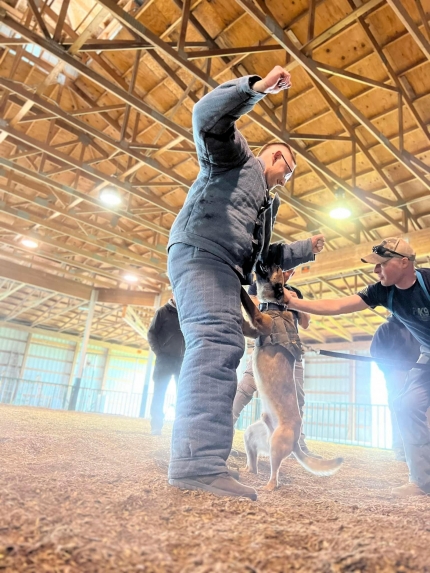
Karo is seen training to get an accurate and effective bite that will be utilized in the field if he is given the command by Sherman.
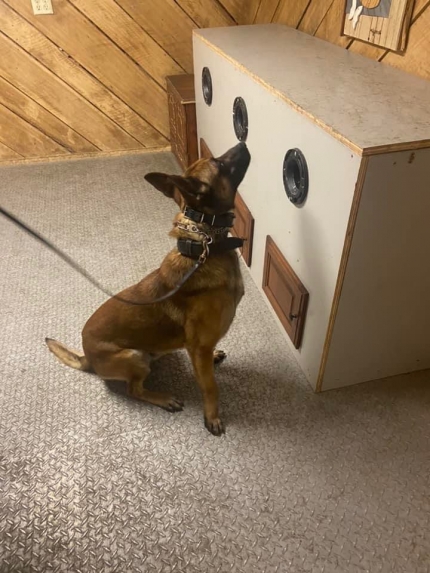
Karo is trained to sit when he detects the scent of certain drugs. The photo shows Karo during a training exercise alerting to one of the drugs
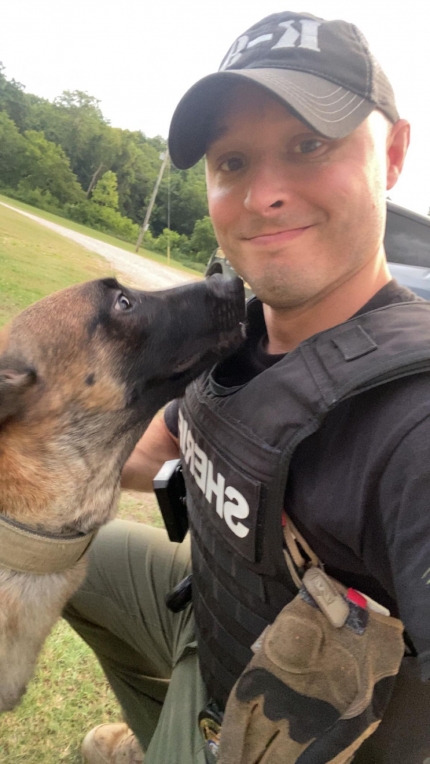
After a six week training in Michigan, handler Deputy Josh Sherman and Karo returned back to Ozark County June 1 and have been working here since that time.
The Ozark County Sheriff’s Department recently welcomed a new member to the team, K9 officer Karo.
Karo, a year and a half old male Belgian Malinois, can sniff out and alert his handler Deputy Josh Sherman to the “big three,” as Sherman calls them: methamphetamine, heroin and cocaine.
What Karo isn’t trained to do is alert to the smell of marijuana, an important factor that is different between him and K9 Rye, the semi-retired 5-year-old German Shepherd that has been with the sheriff’s department since 2020.
The legalization of recreational marijuana in Missouri with the passing of Amendment 3 last fall has put the OCSD and other police departments in a difficult situation with their K9s units, most of which had been trained to sniff out and alert the handler to the presence of marijuana. Case law in Missouri now prevents officers from having probable cause to legally search a vehicle based upon the alert of a K9 that is trained to detect the scent of marijuana.
Rye, who still lives with Sherman (along with Karo and Sherman’s pet dog Ruger), has entered “semi-retirement,” and will mostly be used at and in local schools, a location where it is still illegal to possess marijuana in Missouri.
“She’s a good SRO [school resource officer] dog at this point,” Sherman said.
Another important difference between retiring K9 Rye and the OCSD’s newest canine is that Karo’s training goes beyond the skills of drug detection and human and evidence tracking.
Karo is trained as an apprehension dog, or as a “bite dog,” as it’s sometimes called. When given a command by his handler, Karo will chase down a fleeing subject, bite and hold onto the suspect to secure the person in one spot until officers catch up and apprehend the suspect. He’s also trained to do building searches, area searches and apprehensions for fleeing subjects.
Funding a new K9
As Rye approached year 5 of her life this year, Sherman and Sheriff Cass Martin have been thinking of how the OCSD K9 program would develop as K9 Rye transitioned into retirement. Most K9s retire between ages 5 and 8, Sherman said, meaning Rye would be facing retirement in the next few years.
The K9 program originated and has been sustained completely on donations since the OCSD obtained Rye three years ago. It would nearly impossible for the OCSD to support the K9 program budgetary funds, as the cost of operation at the sheriff’s department has increased drastically in the last few years causing a tight wallet.
Donations and fundraising events have raised some funds for a new K9, but with the cost of replacing and training a new dog nearing $20,000, the sheriff’s office was expecting it to take some time to secure enough donations.
However, the OCSD was thrown a bone earlier this spring when the Missouri Department of Public Safety created the K9 replacement grant program aimed at helping sheriff’s and other police departments replace previously-trained K9s that detected and alerted to marijuana with ones that were not trained to detect and alert to marijuana.
Sherman applied to the program, asking the grant to cover the cost of purchasing the dog, traveling to Michigan and attending a six-week training, along with the needed veterinarian care to get Karo on the road. The grant proposal was approved in full.
Six-week training in Michigan
Sherman left in mid-April to travel back to FM K9 in Michigan, the location where he and Rye completed training for her certification a couple years ago.
“This facility was a one-stop-shop. They gave us everything we were looking for. We told them the kind of dog we wanted to have and [its desired] personality traits as well. FM K9 came through and gave us exactly what we’re looking for,” Sherman said.
The outfit paired the OCSD with Karo, who had been shipped from Belgium last fall and received some early training before Sherman arrived. Right off, Sherman knew he was going to be a good fit for the OCSD. Sherman says Karo’s personality is well-suited to the needs of a rural sheriff’s department.
“He’s got a good switch on him. He can be a guard dog and once that switch flips and he’s given that command, he goes into work mode,” he said.
For six weeks, six days a week, Sherman and Karo trained. Their work included a handlers’ course, which clocked in at a minimum of 240 hours and included instruction on case law, dog training and how handlers can learn how to train the dogs themselves.
“The training was different than it was with Rye because he is what they call a green dog. Rye is 5 now, and she’s a veteran. She knows what to do. I’m just the handler holding the leash at this point,” Sherman said. “This dog, he’s just a year and a half old. He knows what to do, but it’s a give and take. We have to fine-tune it a little bit.”
Sherman said the dog training started with the basics including obedience.
“We had to teach him how to sit, teach him how to lay down. Then going into narcotics, we had to teach him the various commands that I’m seeking on the certain drugs I’m looking for. If you can believe it, teaching dogs drugs is super simple. When they get it, it’s boom, they’ve got it from them on,” he said.
Sherman said the training also included instruction on the apprehension skills.
“We got 32 hours in on how to properly catch a dog or decoy a dog. Decoying is basically the man in the bite suit or with the bite sleeve. It helps focus the dog’s bite. If you have a good decoy, you can really bring a lot out from the dog or fix an error in a dog. So, if a dog is afraid to bite a leg, you can work on that if you have a good decoy,” he explained. “They gave us the fundamentals on how to properly decoy for a dog... The suit, it’s the equivalent to a fire suit. It’s hard to move in it. It’s hot and exhausting, and if you move a ceratin way, you can injure yourself or...you could actually injure the dog too.”
Put to work
Sherman and Karo arrived back in Ozark County June 1, and the pair have been working together since that time. The dog was deployed seven times in the first 30 days with one arrest made due to drugs being present with Karo around the vehicle.
Sherman and Karo also train a minimum of 16 hours a month including a weekly training session with Tito, a K9 at the West Plains Police Department.
“Half the battle is getting him acclimated to our area so when we deploy him he’s comfortable around the officers, the scent of the officers, he knows, in his mind, who’s safe and who’s not,” Sherman says. “The way we train is that I’ll take a few steps out, he’ll come to me, and then we’ll just start running together because we’re a team. He’ll go and lock on to what I’m wanting to do.”
Sherman says that the apprehension work is not always just giving the command and the dog biting a fleeing suspect. Sherman says more often, Karo will track and find suspects.
“If we’re doing a search and someone runs from us out in the woods, he can do what they call a tactical route patrol. I can give him the command, and he’ll go and smell downwind. So if a suspect is hunkered down in the woods, he’ll go so far and then give me an indication that ‘OK, I don’t smell that person anymore.’ Then he’ll go the other way and stop, which means he doesn’t smell that person anymore that way. That zeroes us in on the area the suspect is, and then we can give the command to bite or give the person the command to surrender themselves,” Sherman said.
Karo’s apprehension training is a real asset to the department, Sherman says.
“It’s just crazy the next-level resource we have from this dog... I feel more comfortable knowing that if we have a barricaded subject, if we have a hostage situation, if we have a guy who fled on us - maybe with a weapon, maybe not with a weapon - we can ask ourselves, ‘Is it a dog call, or is it a SWAT call?’ We have that option now. We didn’t before. It has always only been the choice of an officer or going to get the task force. Now, we have a little more of a barrier in between the two, which is nice,” he said.
Sherman says methamphetamine is by far the most prevalent drug that officers encounter here in Ozark County. Although Karo is trained on cocaine and heroin detection, Sherman says it isn’t something he anticipates they’ll come across a lot. Sherman says he’s not seen cocaine in Ozark County yet, and he’s only seen heroin once.
“But meth...it’s almost like marijuana, how prevalent it is. It’s just so readily available right now. It’s everywhere,” he explained. “It’s just hard for us to find right now because, well, they know to hide it from me when they see me coming.”
Sherman says that he’s been asked if Karo or Rye can detect and alert to MDMA (commonly known as ecstasy or molly), which cuts meth, or fentanyl, He says, the answer is yes.
“...Because it is an amphetamine. Anything that is within the compound, the dog alerts to. So, people ask ‘can the dog alert to fentanyl? Well, yeah, because it’s within meth. It’s cut with cocaine. It’s in the other drugs too. So, it’s just a matter of how pure it is,” he said.
Contribute to the K9 fund
The K9 program at the OCSD is operated on a completely donation and grant based system; Sherman assures the Times that current donations full fund the K9s’ food, veterinarian care and anything else the dogs might need. In the case that it doesn’t, the dogs will still be provided for, Sherman said. To make a financial donation or a donation of dog food, toys or other items, contact Sherman at the OCSD, 417-679-4633.