
Residents voice opposition of AI data centers at county meeting
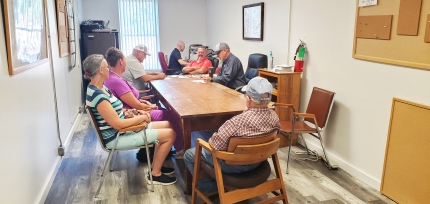
Times photo/Regina Mozingo Several residents showed up for Monday morning’s Ozark County Commissioners meeting to express their concerns about the possibility of AI data centers in the county. A total of eight citizens showed up for the abnormally lengthy meeting. Those pictured are, from left, April DeWeese, Rachel Corter, Western District Commissioner Layne Nance, Ozark County Clerk Brian Wise, Presiding Commissioner Terry Newton, Eastern District Commissioner Jim Britt and Randy Riffey. Others, who came later, were in attendance but not pictured.
Ozark County Commission meetings are usually quiet and quick; normally lasting less than 10 minutes and attended by very few residents. However, as AI data centers creep closer and closer to Ozark County (the nearest one is being built in Webster County near Marshfield, about 66 miles from Gainesville), residents are becoming more concerned about the possibility of a large data center being built in the county and trying to find out what they might be able to do to stop it.
After hearing several rumors, a number of people attended this week’s commission meeting and said they wanted to hear what the commissioners had to say about the controversary.
After showing appreciation to the residents for coming, Presiding Commissioner Terry Newton assured them that he and the other commissioners are against any data centers being established in Ozark County.
“[You] are the first people that I’ve had even come to talk to me about it,” Newton said. “But I’m against [data centers in the county]. 100% against it. I don’t want to see one in the landscape. I know these two guys (Western District Commissioner Layne Nance and Eastern District Commissioner Jim Britt) feel exactly the same way.”
Newton assured those in attendance that they have been researching data centers and what communities can do about keeping the centers out of Ozark County.
“I’ve been digging around trying to find information on all of this,” said Newton. “The options are an ordinance, which they did in Camden County, but all that does is create loopholes that they can jump through, or we can put a moratorium on them, but all that does is stop it for a short amount of time while they do a study to find out what’s going on. But that’s not a guarantee…and the moratoriums and the ordinances are being challenged in court and being overturned in court.”
“How long would it stop them for?” asked Rachel Corter, one of the concerned residents in attendance.
“Just a few months, but some of them have been up to a year when they do a study, though a lot of those have been overturned before they even got started,” said Newton. “Honestly, and I know they’re bad words in Ozark County, but a [planning and zoning board] is the best way we have to combat the centers.”
“Can we do that?” asked Corter. “What do we need to start the planning and zoning.”
“We’ve tried that before,” said Newton.
“It’s done nothing but fall really hard [in the past], and it’ll do nothing but fall all the time,” Ozark County Clerk Brian Wise said.
“If we get enough people to agree to it...is there an election that’s coming up soon where we could put it on the ballot?” Corter asked.
“Do we have funding to even fund a planning and zoning commission?” asked, Adam Freeman, another meeting attendee.
“We don’t have the funding right this second,” answered Wise.
“So essentially what y’all are saying is that we would have to vote to come up with funding for individuals who would change planning and zoning,” asked April DeWeese, another meeting participant.
“...If planning and zoning would pass,” Wise said. “But I think planning and zoning would die [at a] 70-30 [percent rate] in Ozark County. It’s not a money issue…The citizens of Ozark County do not want planning and zoning.”
“We’ve had too many people move here to get away from planning and zoning,” Freeman agreed.
“So basically there’s no planning and zoning allowance for exclusivity for big business cause it would apply across the board to everyone?” asked DeWeese.
“Yes,” Wise answered.
Chances of a data center
Wise reminded those in attendance about similar issues that have been a concern to residents in the county over the years.
“We’ve had [similar] stuff pop up every five years since I’ve been [in the courthouse]. I’ve been here 26 years…and this will be gone in a few months. We’ve had all this stuff pop up like the Blue Waves, the Blue Waterways (conservation initiatives that attempted to put restrictions on individual landowners). Does anybody remember this stuff?”
A few audience members said they did.
“And where has it gone?”
“Not here,” answered Corter.
“That’s right,” said Wise. “It’s not here.”
“So in all honsety, you don’t think they would put an AI data center in Gainesville or in Ozark County?” asked Corter.
“It’s possible,” answered Wise. “But not likely.”
“My gut feeling, and I’ve lived here 58 years, is like Brian, I’ve seen all this go and come,” said Nance. “I don’t see one ever going in Ozark County.”
What new data centers are like
Newton said he’s been doing a lot of research on what the newer data centers being built are like.
“They’ve advanced from the old ones that they started with. They’re building some small scale, which I personally think if they did build one here, it would be one of those on the smaller scale.”
“Like Marshfield’s?” asked Corter.
“I don’t think it would be that big,” assured Newton.
Wise agreed. “A lot of them are the size of a closet. They’ve been around since the 1960s or ‘70s.”
Many of them also leave a smaller ecological footprint than their predecessors, added Newton.
“A lot of them they’re building now are a close-looped water system. In other words, they don’t use much more than what a household does…A lot of them are using their own power grids.”
According to Florida Water and Pollution Control, a closed-loop water data center utilizes a sealed, recirculating coolant system to remove heat from servers. Unlike traditional open-loop designs that continuously evaporate water into the air, a closed-loop system is filled once and continuously recycles the fluid, reducing day-to-day cooling water consumption to nearly zero. For example, a closed-loop campus can peak at just 22,000 gallons of daily water use (used primarily for standard business operations like restrooms) compared to 5,000,000 gallons daily in similar evaporative systems.
Would planning and zoning help–
or hurt the Ozark County way of life
In a similar fashion of past initiatives that have brought the possiblity of large-scale change in Ozark County, the juxtaposition of local economics and small-town life is brought to the forefront of residents’ minds.
“We do need some economic development and STEM implementation in this county,” Freeman said. “I don’t know if it’s a data center… [but] we do have to give our young men and our families infrastructure to survive right here… There needs to be a simple change in perspective not necessarily a data center because we all know that industry can tear up our waterways and our land and cause issues. We have to regulate and this is a very small county….
“I think that when you (the commissioners) are with the governor next week, you can ask where is our state STEM workforce development program? Why isn’t it being brought here? Why don’t we have it? [Large companies] are looking to…develop small communities just like this. They want hub zones…
“This is a very economically undeveloped part of the state. We all can agree with that,” Freeman continued. “We like it that way, but…”
“I for one like it just like that and don’t want it to change, no offense,” Corter said.
“But one manufacturing facility isn’t going to hurt it,” Freeman responded.
“One brings in more,” Corter said. “When one comes in, then they all come in. And I’m sorry, I’m against it 100 percent. I’m 5,000 percent against growing down here.”
“And that’s when I’ll tell you this: we will go broke …and you won’t have any infrastructure in five years,” said Freeman.
“Most of us who live here are poor,” Corter responded. “But... we get the life we have here. If you change it, you bring all these people in, you bring all these jobs in, our way of life here will change… the small towns, the small communities will change.”
“This right here, this back and forth, these two separate opinions, have been in Ozark County for all our lives,” said Britt. “But what you (Corter) said right there, is the #1 reason why planning and zoning won’t work in Ozark County. You just made the case against what you want to do.”
“So if say someone bought or sold 800 acres, like in Pontiac, what could they do with that?” asked Trevor Grozis, who also attended the meeting.
“Anything they wanted to,” Wise responded.
“Everyone in Ozark County wants to buy their land and do what they want to do with their land,” said Britt. “But we can’t let you do what you want to on your land and stop [the large companies from also doing that]. That’s the catch 22 on that.”
“So it’s coming,” Willam Smith, another citizen attendee said. “We gotta change. This (letting people know about the data centers) is a good thing.”
“This is just the beginning,” said Freeman.
“This is a good thing to start worrying about because there’s going to be other things,” added Smith.
Nance said the commissioners get blamed many times because big businesses don’t come to Ozark County. “A lot of them won’t come here because of where we’re at. We’re not close to an airport or a railroad.”
Britt, who served in Ozark County as a Missouri State Highway trooper in Troop G for decades, agreed, giving an additional explanation why big businesses don’t want to come to Ozark County. “Troop G has no interstate. And Ozark and Douglas County are the only ones in that troop that has no four-lane highway.That’s what I love about it, said Britt. “But most of the big companies - that’s what they need.”
Final thoughts
“What I hate is…we’ve got so many people running for office at every single level, and they’re using this as a platform to get people stirred up,” said Newton.
“If you guys don’t know your governor, you need to,” said Wise.
“Yeah, our governor (Mike Kehoe) sold us out,” added Nance.
“That’s what we’re worried about,” said Corter. “How do we fight it, though?”
“Come to your local commission [like you are doing] and work with them. Try to help them figure out ways to stop this,” said Newton. “There are people who are running for office who say they can [stop the data centers as one person]. Well, come to us, we’ll give you the credit…and then run on good morals and what you’ve done instead of false accusations or falsehoods,” Newton said.
“That’s what gripes me. You see this statewide, on every level. They’re running for public office and they’re using this [issue] to stir people up. That’s what we’re trying to help people be aware of.”
“I think one of the big things is, right this second, nobody has talked to you,” said Wise, referencing companies who would propose a AI data center here.
“We’ve not been approached by anybody,” said Nance. “We are all against it.”
“Absolutely,” said Britt. “But we have not been contacted.”
“If we get approached you’ll know it,” said Newton.
“But to reiterate, they don’t have to be approached by anybody,” added Wise.
“There are certain people who are just sitting out there, just stirring and stirring it, but they can’t do any more about it than we can,” said Newton. “As a matter of fact they can’t do as much about it as we can cause they’re just one individual out there…
“If you have a question, don’t be afraid to walk in the door and ask, we’ll answer it.”
More information
To contact the commissioners, call 417-679-4096 or email ozarkcountycommission@outlook.com.