
ACTION RECOVERY CENTER: In-house drug, alcohol treatment programs to open in Gainesville
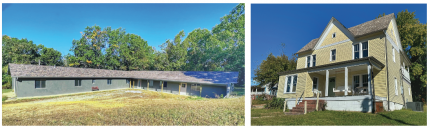
Times photos/Jessi Dreckman Action Recovery Center (ARC) will be operating two in-house residential drug and alcohol addiction treatment programs or “sober living homes” in Gainesville for Ozark County residents. The men’s housing unit (above, left) opens today, Nov. 1, in a building off Highway 5, south of Gainesville. The women’s housing unit (above, right) is slated to open Jan. 1, at its location in the historic three-story yellow home on Third Street, also in Gainesville.
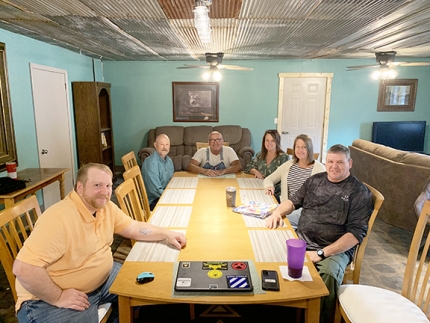
Times photo/Jessi Dreckman The Action Recovery Center (ARC) advisory board includes, clockwise from bottom left, ARC supervisor Brandon Cohn, accountant Richard Mustion, pastor/addiction counselor Jeff Dotson, Ozark County Circuit Clerk Jackie Smith, building owner Amber McGinnis and ARC supervisor Mike Perryman. Not pictured: Racheal Crosby, retired probation and parole officer Misty Brackney and retired social worker Karla Smith.
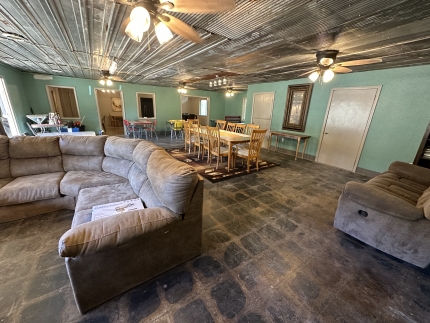
Times photo/Jessi Dreckman The men’s ARC home has been decorated to be homey and inviting. The large living and dining space, pictured here, includes a comfortable sectional couch and reclining chair, TV with DVD player and several tables for dining or sitting.

Times photo/Jessi Dreckman Men enrolled in ARC will live at the home for nine to 12 months. Each resident will have his own bed, access to bathrooms and a large living and dining area.
Many residents in Ozark County have been impacted by addiction - either struggling themselves or seeing a family member or loved one in the throws of battle. Broken homes, broken families and broken individuals lie in the wake of addiction-fueled lives here and elsewhere.
But unlike more urban areas, Ozark County residents face additional challenges to getting sober. With limited resources available locally and many individuals without a vehicle, getting help can feel daunting Now, thanks to the hard work of a group of local individuals, addiction recovery is within reach inside the borders of Ozark County.
Today marks the opening day of the new Action Recovery Center (ARC), a 13-bed men’s in-house residential drug and alcohol addiction treatment facility, located on Highway 5, south of Gainesville.
A second ARC location, which will be open to Ozark County women fighting drug or alcohol addiction, is slated for its opening Jan. 1, 2024. The men’s facility has 13 beds available for residents, while the women’s facility will have six beds open.
ARC men’s facility
To be eligible, those applying for the ARC program must be at least 18 years old and live in Ozark County. They must also be battling drug and/or alcohol addiction, decide that they want help and be willing to follow the program rules.
Applications can be accepted from those who are court-ordered to enter a treatment facility or from individuals who decide on their own that they need help getting sober.
“We don’t want people who have to be here. We want people to want to be here. We are going to have people who are court ordered, but if they don’t want to be here, they can go to jail. We’re not going to fight you to stay here,” building owner and ARC Advisory Board Member Amber McGinnis told the Times. Those with violent and/or sexual offense background are not eligible for the program.
The ARC program is 9 months long (although residents can choose to stay for a full year if they want), and those enrolled will be required to live at the facility.
“We’ve really tried to make it homey and nice,” Amber said. “Because this is a home. It’s not a hospital or some sterile medical facility. This is home for these men while they are here.” The space features a large, open and well-decorated living and dining room with sectional sofa, reclining chair, long family-style tables and other smaller tables. One long wing on the back side of the house features a hallway with the bedrooms and bathrooms lined up together. A full kitchen, store room, office and counseling rooms are also outfitted and ready for use.
Outside behind the facility, a large grassy area will be transitioned into raised bed gardens, and an outdoor screened-in porch will become a greenhouse that residents can use to grow fruits, vegetables and other plants. Organizers plan to get chickens and possibly bees for residents to care for. A basketball goal will be installed, and picnic tables will be placed in the yard for residents to enjoy outdoors.
While program participants are at ARC, all transportation will be provided by staff members (transportation is limited to approved work, medical visits, court hearings or court-ordered classes). Three home-cooked meals will be cooked and served to the residents each day, and clothing, toiletries and other life necessities will be provided.
“When they arrive, they’ll get a kit that includes brand new bed sheets, shampoo, razor, toothbrush, toothpaste... everything they need, and an outfit,” Amber said.
The facility has acquired several boxes of steel-toed shoes, brand new Carhartt jeans and other clothing items that will be housed in a closet for residents to have as they need.
While they are enrolled in the ARC program, residents’ court costs, required child support and other bills will be paid so that residents can focus on getting sober without the added stress of financial burdens.
There will be counseling services offered in-house, as well as optional church services. Residents can opt out of religious services if they choose. ARC is not a faith-based program, and religion is not a required element of residency.
Program participants will have bank accounts opened and will be taught financial responsibility and how to manage money.
Full-time employment is guaranteed and required by residents actively in the program. ARC will provide and assign the employment. Organizers say they have currently secured five full-time positions at $14 per hour at a factory in Mountain Home, Arkansas. Other employment positions will be needed as residents are accepted. Local business owners who would like to offer jobs to ARC residents can call the organization’s office at 417-372-1002 to discuss.
There will be $200 per week deducted from residents’ paychecks that will go to pay for their stay at the facility, which includes all food and other provided items. The rest of the money will be deposited into a savings account that the resident will receive after they graduate from the program.
Toward the end of the program, staff will work to get residents their driver’s license (if they do not already have one) and work to set up future housing and transportation so they can be successful on their own. Organizers estimate that graduates’ savings accounts should each have between $5,000 to $10,000 at the end of the 9-month program, which will be used to purchase a vehicle and get them into their own rental home or other housing situation.
The residents will be able to keep the jobs they secure while in the ARC program after graduating. Organizers expect that residents will have health insurance benefits after 30 days and will qualify for 401k and other benefits at their jobs after a year, which will be an incentive to keep the employment after graduation.
There will be at least one full-time staff member at the ARC house location 24/7. Currently, two former Department of Corrections prison employees have been hired for the job. They will serve three days on, three days off in 24-hour shifts, Amber says.
While living there, residents will have a two-week period to become adjusted to the new living situation and go through the worst of addiction withdrawal symptoms before they will be expected to begin work.
Amber says those applying should be warned that the rules will be strict. Residents are not allowed to have cars, cell phones or internet access while living at the facility. Family visits must be approved and are only allowed on the weekend. Residents must work full time, and while cigarettes are allowed, there will be no vaping or use of marijuana or illegal substances. Residents will submit to regular drug and alcohol testing on site. They will also be assigned chores, will do their own housework, cleaning and laundry. “This whole building, inside and out, will be maintained by the residents themselves,” Amber said.
Oversight with the advisory board
In addition to the full-time staff, the ARC programs will be led by the Action Recovery Center’s advisory board, which will meet once a month.
The board includes seven members who offer various insight derived from differing backgrounds that include serving in the local court system, as corrections officers, as a probation and parole officer, as an accountant, as a former social worker, as a faith-based recovery counselor and as the mother of two children who have successfully graduated from addiction recovery programs. Two of the members are new residents to Ozark County, meaning they have no prior knowledge or pre-conceived notions about local individuals.
The ARC program is not affiliated with the Missouri Department of Corrections, so it does not receive funding in that way. That also means that the program organizers retain control of the program. If Missouri Department of Corrections funding was used, officials with the prison organization could dictate how the program is run and who ARC must accept. At present, local organizers want to only offer the program to those in Ozark County, and it is expected all spots will be filled that way.
ARC hopes to sustain itself with low overhead and the aid of grants when available, donations and future fundraising efforts.
Future plans
The women’s facility will open at its location on Third Street in Gainesville (across from the Ozark County Health Department) on Jan. 1. The ARC advisory board hopes to have the men’s facility running well and to have learned what works and what doesn’t work by that time.
At that facility, the ARC program hopes to have a “house mom,” who will serve as the full-time live-in program administrator in exchange for free housing at the home. That facility is expected to have six beds available.
Looking further into the future, Amber says that the long-term goal for both the women’s and men’s ARC programs is to be self-sustaining and create enough funding to open and run a children’s home, where children who are displaced or in the foster care system can live until they are reunited with their family or placed into permanent homes. “It goes hand-in-hand... addiction and the DFS system,” Amber said, referring to the Missouri Division of Family Services organization, which oversees the state’s foster system.
Although she said she wasn’t sure of current numbers, Amber was told at one time that there were more than 30 children from Ozark County in the foster care system and only one foster family. That means that most of the children are being sent to other ares of the state, and siblings are not kept together most of the time, often creating chaos in the children’s lives.
A children’s home would allow the kids to remain in the county and attending their home schools, creating more normalcy despite their removal from their homes and families.
How you can help?
The ARC program is currently accepting volunteers and donations.
ARC is under the umbrella of the Ozark County Substance Abuse Task Force, a 501c3 charity organization, meaning financial donations are tax deductible and gladly accepted. Donations of hygiene products, paper towels, toilet paper, new clothing, artwork for the bedrooms and other living necessities are also appreciated.
Volunteers are needed as drivers, cooks, to give testimonials and in other capacities. “We can use you in whatever way you can help,” Amber said. “We’d love to have people come in to just visit with the residents... play games, cards... that kind of thing. We’ll have the coffee pot on and ready.”
An idea that took hold
The idea to build an in-house drug treatment facility in Ozark County has been discussed for decades, but despite good intentions, efforts seemed to have fizzled out before they materialized; however, the most recent effort, which has been in motion for about two years, has really taken shape.
The seed of the project was planted back in 2021 when Amber sold her business, S&L Recycling, in Mountain Home, Arkansas. She decided that she wanted to invest the money she made from the business, along with some funds she made while “flipping” several houses in the Mountain Home area, into other investment properties. Having lived in Mountain Home for several years, she also decided she wanted to move back home to Ozark County.
Jumping all in, Amber decided to purchase two unique properties in Gainesville “on the same day,” she said. The first property was originally built as a multi-bedroom residential home for mentally-handicapped individuals in the late 1970s. The second property is one of the oldest homes still standing in Gainesville, a two-story yellow structure that dates back to 1898 when Hawk Walker built it.
Amber told the Times that she had no idea what she was going to do with either building at first. She got to work renovating the structures and brainstorming their purposes.
She considered renovating the facility on Highway 5 into a dorm-style rental unit where young college kids could pay a minimal rent but have their own space and move out from their parents’ home. For the yellow house, she considered opening a bed and breakfast, or outfitting the place with kitchen equipment for a delivery business or other restaurant-type facility. She also considered renting both places as short-term rentals through sites like VRBO or Airbnb.
“Then I called Jeff [Dotson] one day, and I was telling him I bought [the facility on Highway 5]. He said, ‘You bought that?’ I told him, yes, but I didn’t know what I was going to do with it. He said, ‘I do!’ And he was down here that day,” Amber said.
Dotson, who has been a longtime advocate for addiction treatment in Ozark County and has offered his support and counseling at the Mission Square Church in Gainesville for many years, told Amber that she should work with the Ozark County Substance Abuse Task Force to transition the spaces into sober living homes.
“Jeff actually bought this place 20 years ago to do the same thing with it. They were going to start The Soaring Eagle at that time, and it ended up falling through. So this place was bought one other time for the exact thing. That’s why he was so excited. And then he started in on me on the yellow house. He said we need the yellow house for this too.”
Convinced of the need of such a program here, Amber continued with the renovations with that goal in mind.
The facility on Highway 5 received a new roof, new plumbing to replace pipes that had busted, all new lighting, new electrical wiring throughout the building, a full kitchen, new sheet rock in all the rooms, new tile floors throughout the building, renovated bathrooms and new painting, trim and doors.
A new heating and cooling system was also installed, thanks to a $15,000 stipend obtained by the Ozark County Commissioners as a result of a settlement the county received from a nationwide settlement against several drug manufacturers due to the opioid epidemic. “We are so thankful to Terry Newton, Layne Nance and Gary Collins for that. They all voted for it and are supportive of this effort,” Amber said.
“Ozark County joined the lawsuit a few years ago, and we receive our first settlement payment late last year and a couple of smaller payments this year. The money is earmarked to help drug use and prevention, and with the new facilities being put together in Ozark County, we thought they were a perfect use of these funds.”
The yellow house has also received a full renovation. More details about that project will be shared when the women’s facility opens in January.
Find out more
To find out more about the ARC program or how to apply, call the office at 417-372-1002 or email actionrecoverycenter@gmail.com.