
Fifty people attend commissioners’ meeting in opposition of sheriff’s department cameras
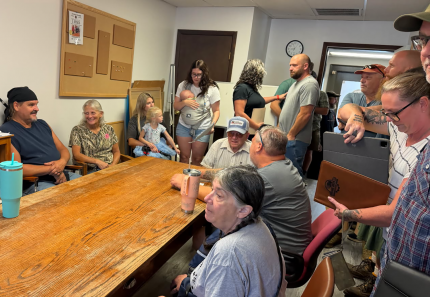
About 50 people attended Monday morning’s Ozark County commissioners meeting, cramming into the tiny meeting room (with many spilling out into the hallway) to voice concern and opposition against two license plate-reading cameras that were recently installed in Gainesville and Hardenville on a trial basis.
Last week, several county residents were at the Ozark County Commissioners meeting in favor of the controversial Verkada cameras installed by the sheriff’s department, but this week told a very different story. Around 50 people filled the upstairs meeting room, spilling out the door and down the hallway past the upstairs courtroom - and all in attendance were against the installation of the cameras. The often heated discussion left some residents feeling frustrated and unheard while others felt that their opinions were validated by the commissioners.
Installed by the Ozark County Sheriff’s Office, the cameras are currently part of a temporary trial, situated in two different sites in Ozark County. The sheriff says the trial will last 31 days, but the installation has received a lot of responses from both sides of the issue.
Monday’s crowd voiced various reasons they were against the use of such cameras - from the possibility of receiving tickets for traffic offenses to violation of privacy to worries about foreign governments using the information against citizens.
Ozark County resident Allison Blache started off the discussion.
“I am definitely against these cameras because I think in Ozark County our biggest problem is property theft more than business stuff. I have cameras on my property. I pay for them. I pay for them to be monitored. I keep an eye on them and if I need help I can call the sheriff’s office.
“I don’t ask for any of these folks [the county or sheriff’s office] to pay for my cameras or pay for them to be watched or have someone watch them. I do it myself,” she continued. “I feel like if these businesses are being targeted then the businesses needs to have the cameras...that way they can pay for it. They can keep an eye on it, and we don’t have to be responsible or feel like we are being tracked.”
Presiding Commissioner Terry Newton assured Blache and those in attendance that no county money has been spent for the cameras themselves or the monitoring, as they are currently installed on a free trial basis.
“It will be,” Blache insisted.
Newton told her that he had the understanding that even if the cameras would not be used by the county in the future, owners of both businesses where the cameras are located, Miller’s Kountry Store at the intersection of Highway 160 and J Highway in Hardenville and West Plains Propane at the junction of Highways 5 and 160 in Gainesville, plan to keep the cameras.
“Well then they need to point them toward the business not toward the highway,” said Blache. “Miller’s [camera] goes right up J Highway, I came in on it today.”
“It covers the parking lot,” said Newton.
“No it doesn’t,” said Blache.
“Yeah it does. I’ve seen pictures of a car in the parking lot,” Newton responded.
“The camera sits on the outside of that awning,” Blache said.
“I know that, but it takes pictures [in a large area],” Newton tried to assure her. “I’ve seen pictures that it took, and it’s in their parking lot.”
“Well, coming up on J Highway to 160, I’m being watched,” Blache replied. “And eventually - because I don’t trust the government - eventually they can turn it around and say ‘OK these people are used to this now. They don’t have a headlight on, let’s mail them a ticket. They didn’t stop long enough at the stop sign, let’s mail them a ticket... The government has the tendency to overreach no matter who’s in office.
“There’s also one up at the propane company up here.”
Newton told everyone that the cameras located at West Plains Propane are watching the propane office, as well as the gas pumps and storage units located across the highway.
One woman asked if the Ozark County Sheriff’s Department had access to those cameras, and Newton responded that the access is on a trial basis.
Why was the public not informed?
“Nobody... said ‘OK let’s go to the Gainesville ballpark, and let’s have a meeting ‘cause I want to see what you people think about what we want to do,” said Blache. “We voted for these people. We pay our taxes. We have a right to know what’s going on in our county.”
“When you voted for [the sheriff, Did] you give him the right to make decisions, and check out things and do things?” Newton asked her.
“To check things out but not without us acknowledging it, not something like [this],” answered Blache.
“OK. Let me ask you something,” countered Newton. “These guys (pointing to Eastern District Commissioner Jim Britt and Western District Commissioner Layne Nance) spend two days a month paying bills and signing checks. Do you want me to call you when they do all that stuff? I’m just asking you. Do you want me to call you, or did you give us the ability to take care of all that?”
“I gave you guys the ability to do what you need to do,” answered Blache. “But I’m the president of Ozarker Science Club … I don’t do anything without the club’s approval.”
“OK,” Newton continued. “I’m just asking. Do you want us to call you every month when we do bills and payroll?”
“If it’s something out of the ordinary, yeah,” answered Blache.
Concerns about tracking
“This is something that’s huge around the country,” one audience member, who hadn’t left his name on the sign in sheet, said. “This is something that has caused so many problems around the country. There’s been so much push-back already. So this is something that I think the citizens of the county were like ‘wait a minute.’”
“Who tracks you on your phones?” asked Newton.
“Those are paid for by us, and we know that that is there,” she answered.
The question also elicited answers from many others in the audience at the same time.
“What about when you go to Walmart, when you go into the bank, when you go into a convenience store?”
“We don’t have to shop at Walmart,” said one audience member.
“That’s right,” said another. “That is choice.”
Is consent needed?
Dora resident Gus Breton agreed that he wanted no surveillance. “However, coming from New Hampshire there was a lot of stuff while I was still there about the…expectation of privacy when you’re in the public. So if [the businesses] owns the cameras, they own the data that’s on the cameras. So if it doesn’t leave the store, it’s still basically private data.
“I have a camera on my driveway pointing at both sides, and it’s basically the same thing. It’s my camera; it’s my data. As far as pointing it out to the [public] road there’s no expectation of privacy on a public road or in the public.
“I understand all of that but one of the questions I have is,” he said while gesturing toward his wife. “So, it looks like my wife is video taping. Does notice need to be given for that to the people [here]? Do we have to get consent for the video?”
Ozark County Clerk Brian Wise told Breton that Missouri is a one-party consent state, meaning that, by law, the other person or persons being recorded do not have to be told they are being recorded.
What happens after the grant?
Michelle Ridgway asked what happens to the cameras after the grant runs out. “So normally, by my own research, grants are directly to the…sheriff’s department. So then they’re on these people’s properties, who have given permission, correct? What happens outside of that two-year grant mark ‘cause that’s when the grant ends.”
In reference to the insinuation that the cameras are being paid for by a grant, a tidbit that has been shared in various posts on social media as well, the Times reached out to Sheriff Cass Martin to ask if that was true. He assured staff at the newspaper that the grant the sheriff’s department received was only for the 31 day trial, as he had previously stated. There has never been a two-year grant issued to the OCSD for the cameras, he explained.
Newton told the audience that if the sheriff’s department decides not to keep the cameras, and the businesses want to keep them, that the businesses will pay for them.
“So will the sheriff’s department, even after that grant, still have that access to [the camera footage]?” asked Ridgway.
“Only if those people give [access],” said Newton.
Later in the meeting, county resident Cheryl Fortuna asked the commissioners to clarify that answer. “The cameras were put up by [Sheriff] Cass [Martin] and with grant money given to Cass. But then you just told us that they were privately managed by these particular businesses.”
“He’s watching it during the [grant] time frame but once that time frame is done, the businesses [may] plan on keeping them,” answered Newton.
“So the sheriff is monitoring them during the grant-time frame. That’s the clarification I think we were all wanting... is exactly what kind of access is being [given] to the cameras outside of the private businesses. Private businesses we totally get.” said Fortuna.
Law enforcement?
The commissioners continued to field more comments about where the cameras are pointed with the majority of those present expressing opposition against the cameras being pointed toward public highways at all, many say their concern is due to the possibility of the cameras being used to enforce traffic laws.
“So if I get a ticket in the mail…,” started one woman.
“You’re not going to get a ticket in the mail,” said Newton.
“Well that’s what’s happening with a lot of these cameras,” she responded.
Commissioner Jim Britt answered her. “I get that [it’s a concern] - a ‘what if.’”
“It’s not a ‘what if.’ Technology changes,” she said.
“You’re right. It does,” Britt agreed. “But if [tickets given because of the cameras] were to happen, we would be the first three to tell the sheriff to get rid of these cameras. But, they are not put up for enforcement reasons. They are not there to write tickets… Once again, you’re seeing stuff on Facebook, on the internet, about what could happen. And it could happen.”
“It is happening,” said one man in the audience.
Britt agreed. “Yes, it can happen. It is happening–but not here. So I’m saying I [understand] the fear,” he said.
“What do you have in place to prevent this from happening or control who has access to the cameras?” asked Adrian McGlaughlin, who owns Ozark Diesel and Off Road in Gainesville.
“You told this group that you had looked at the pictures, and you saw what they were,” he said as he addressed Newton.
“Cass showed me the pictures, but I don’t have access to them,” Newton answered.
“So, what can we do to hold these people accountable? To make sure that they’re doing the right thing and use them how they’re supposed to?” asked Gainesville resident Abbey Strain.
“You can go directly to them,” answered Newton.
“I’ve tried,” responded Strain. “She emailed,” she said, pointing to another woman sitting in the room. “All these people in here have tried to contact the sheriff’s department and contact specifically Cass.”
“Let me ask … a question,” Newton said. “[Someone] said we couldn’t point the cameras off the property.”
“It should be pointed at [the business] property,” answered one woman.
“How many lawsuits have you seen against people who have these ring cameras on their front door that point out onto the streets? I’m just asking a question,” said Newton.
Once again, several people answered at once.
“Why are you so combative?” asked one woman. “You’re talking to us like you don’t like us.”
“You’re being very adversarial,” another man added. “We have a lot more in common with you than you think.”
Who owns the data?
“I think that’s the big question... Does Verkada own the data, or does the sheriff’s department?” audience member Levi Gunn said.
Several audience members echoed that question, including one woman who formerly worked on government proposals from large corporations. “In 2008-2009, I worked on the NSA contract that basically enabled them to pull all–and I mean all–video, telephone, anything that’s going over wifi, anything digital. [It’s] pulled into servers and backed up. Whether you want to accept it or not, whether you want to realize it or not, it really is.…it is going on.
“So if it’s in the cloud, it’s already captured by the NSA, and it’s already captured by whoever owns those cameras…Your information really isn’t secure no matter what you want to say.
“And, yes, you can try to narrow it down to…these are the only people who are going to see it,” she continued. “I get that but the company’s got it and they can use it any way they want. They can sell it to whom they wish, and they will.”
“The problem is the capability,” said Ridgway. “I’m not against cameras. I’m against these cameras.”
Future concerns
“Our main concern isn’t what they’re being used for now,” said Jacob, a resident from Dora, “but what they’re capable of being used for in the future with corrupt government, which we all know government is corrupt.
“Our constitutional rights are absolute. And I know that this isn’t technically against our constitutional rights because it is a public roadway, but Benjamin Franklin said ‘those who give up essential liberty for temporary security are entitled to neither...’ The CIA is definitely going to have access to these cameras, and they’re already tracking us. Let’s not give them another avenue.”
Dana Williams, who also lives off J Highway, told the commissioners that she actually contacted Verkada Monday morning in an attempt to learn more about the manufacturing of the cameras.
“I asked them where their cameras were made, where were they manufactured. The first gentleman I spoke to said they were manufactured right there in California, and I knew that was not accurate. They don’t have a manufacturing facility there. They transferred me, and I was then told they were made in Taiwan.”
Williams, who along with many others came prepared with written statements and information, reported that a February 2025 bulletin from the Department of Homeland Security had warned about similar cameras.
“[The bulletin] warned that Chinese made, internet connected cameras give Beijing the ability to conduct espionage or disrupt US critical infrastructure. Despite an SEC import ban on these products, numbers have grown up to 40% year-on-year largely through white-labeled third party manufacturers, which is probably how this manufacturer was able to tell me that these were made in the United States, which obviously was factually untrue.
“My concern is not the government here in Ozark County. I’m really not worried about that,” said Williams. “And who was asking if we had cameras on our properties? I’ve heard it asked several times, and I found it pretty rude. That’s not what we’re here talking about. But personally, we do not have cameras on our property because we don’t want them to be connected to the internet. We’re not comfortable with that. And we’re not comfortable with them looking every single time we come to town, letting China and whoever else wants to know what we have going on. That’s none of their business.
“Verkada’s vision - this is their vision, it’s on the internet, you can find it in several places... Their vision is to be the operating system that runs every building in the world,” she continued. “Nobody here wants that.”
“We’re not here to attack you,” Williams told the commissioners. “It seems like you’ve felt like this has been a personal affront on you.”
“Well, when everybody’s talking at one time, it kind of feels like that,” Newton responded.
“We apologize for that,” said one woman.
“That’s not our intent, let’s be clear,” said Ridgway.
“But we have real concerns,” added Williams. “It’s not that we’re saying we don’t trust you. We do not trust China.”
Williams also brought up that Verkada’s website had information on facial recognition. “This is from Verkada’s website: Facial recognition technology is becoming ubiquitous in our lives today and demand for its application is growing…
“I don’t think it’s growing here,” said Williams. “It may be growing in other places. But, I really don’t think that its growing here. And these cameras - I looked it up specifically - these have facial recognition technology.
“They can tell how many people are in your car. They track you. They make a profile for every person that’s driving by, for every car that’s driving by, for every customer that goes into that store, for anyone walking by. There are individual profiles that are accessible to anybody who can hack into their system…and that is pretty dangerous.”
“And according to Verkada’s website it can integrate with Flock cameras,” added Ridgway. “We just want you to listen to what we are saying because we understand both sides. It sounds awesome, but there’s so much more to it.”
Sheriff controls his own department
“Let me speak a minute ‘cause I don’t speak much,” said Western District Commissioner Nance. “What I get tired of is getting the blame on Facebook for something we have no control over. I’m not for or against the cameras, and I’ll be the first to say I don’t know enough about them, and I’m trying to brush up on them, but if you want these things outlawed, then you need to go to your representatives, your legislators. They’re not illegal in the state of Missouri. I’m not saying the sheriff should or shouldn’t [use them.”
“Don’t you represent us?” asked a member of the crowd.
“Yes I do represent you, but we don’t have the say. We’re not the ones that made the decision to put them up, and we can’t tell [the Sheriff]…”
“There’s three of you and only one of him,” interrupted Blache.
“Yeah, but we can’t tell him he can’t put them up,” said Nance. “That’s the thing. It’s his department.
“The only control [we have] over the sheriff’s department is at the beginning of the year when we approve or disapprove of his budget. After that, it’s his baby. And that’s by law.”
“What’s the point of this meeting if the people who make the decisions aren’t here?” asked one man.
“We have this meeting every Monday at 9 o’clock,” answered Newton. “Nobody contacted us and asked to be put on the agenda. We didn’t know you were coming.”
“And I appreciate all of your time,” said Williams. “But I really think you can affect more change than what you’re willing to tell us that you can.”
More future concerns
“We’re talking about Biblical stuff,” said one man. “I don’t care who believes it. They will set up a surveillance state. They will monitor and track us. They will digitize our money. They will stop us from freedom. Our freedom. You’re cracking the door. We’re cracking the door open right now. That’s all I got to say.”
“This is not new,” said Breton. “The Echelon System came out in the 80s. They were monitoring peoples’ voices… That was before 1990. They had license plate readers back then to monitor your on ramp and off ramp activity, so they could tax you for that.”
“They have been perfecting and waiting until the time is right, and it’s right now,” added another man. “Why do you think there’s a huge push. Why do you think they’re coming out everywhere? We didn’t hear about this until a few months ago. It’s scary stuff going on in the world.”
“And, in my opinion, Ozark County and Douglas County and this backwoods area is going to be the last stand,” Blache added. “We’re going to be the ones hiding in the trees, fighting for our country, and we can’t do that if we’re being constantly monitored by these cameras. My cameras go to my data. They don’t go to the cloud, and that’s for a reason.”
Information for the commissioners
Ridgway and her husband Lane handed the commissioners a packet of information they had prepared.
“I urge you to reconsider your current stance on the Verkada cameras which do in fact have eerily similar capabilities to Flock cameras. We have provided information in the literature that we brought for you all in hopes and prayers that y’all will just read it and just consider what we’re saying,” she read from a prepared statement. “These cameras invert the very nature of how police are supposed to function. With these cameras, we are under investigation every time we drive by the cameras. Our fourth amendment rights are violated every day as a matter of current practice.
“These cameras are a tool for investigating pre-crimes, not crimes, but pre-crimes. The very nature of this technology categorically precludes that. This is not a technology that can be regulated or managed. To believe otherwise is hubris. I wish to support my local law enforcement and work with them as a community,” she said.
The meeting continued for several more minutes, as commissioners continued to hear from those in attendance. No official action was taken.