
Affirmation of the American Dream: Pioneer homestead of King David and Mary Mahan
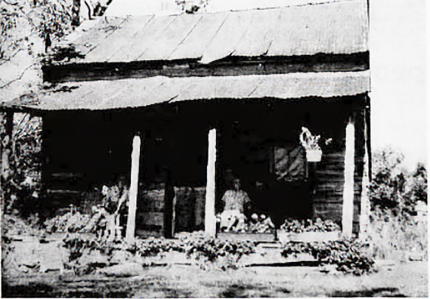
The King David and Mary Stone Mahan log cabin on the Mahan homestead first settled in 1860. On the porch are Mrs. Mahan and her daughter, Ruby Wallace.
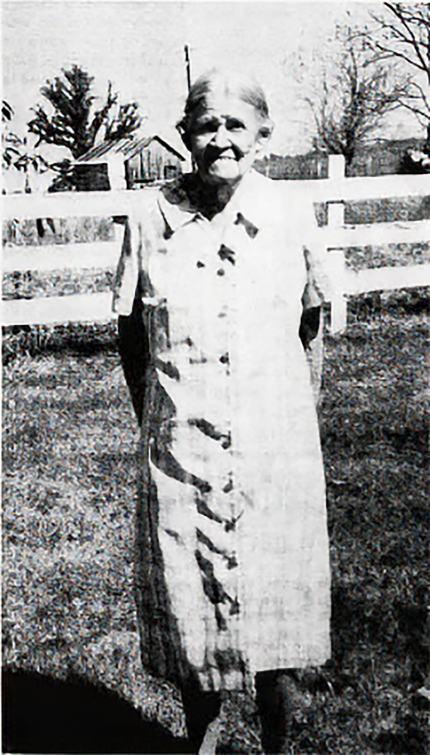
Minnie Duckworth, who celebrated her 91st birthday last month [in 1976], in the yard at the side of the pioneer cabin built by her husband’s parents.
Reprinted from the Oct. 28, 1976 edition of the Ozark County Times – The American Dream–freedom, achievement, reward–is affirmed in the history of many of Ozark county’s homestead settlements.
Imagine the dreams of Tennesseans King David Mahan Sr., and his wife, Mary Stone Mahan, when they came to the high rolling land in northwestern Ozark county in 1860 and decided to make their home there. They chose a simply beautiful site in a well-timbered area drained by Pond Fork and watered by many springs.
After leaving Tennessee, and before coming to Ozark county, they had lived for a time in Webster county. When they moved, Mahan’s two brothers, John and Noah, and their families, came with them. But the John Mahans and the Noah Mahans chose to settle in the Rockbridge area of the county.
In 1863, when the Homestead Act went into effect, King David and Mary Mahan laid claim to 160 acres. They did not file their claim until 1877 and their land grant was signed by President Rutherford B. Hayes.
Imagine their work in making a home; clearing the land to plant crops and provide pasture; providing clothes, food and medicine for the family; and helping to build a school and church as more settlers came to the area.
Their freedom was limited only by their environment and their ability; their rewards extend to their descendants.
Aware of their heritage, the great-grandchildren of King David and Mary were instrumental in preserving for view the front of their old log cabin home as a monument to their achievements.
When plans were made a few years ago to put siding on the old structure to snug it up as a dwelling, the grandchildren asked that the front of the cabin be left uncovered.
This is the second cabin built by the original settlers, the first burned a few years after it as completed. In later years, the old shake roof was replaced by tin roofing and this also remains uncovered.
The cabin is now occupied by Minni Duckworth Mahan, the widow of King David Mahan Jr., who died in 1936.
The original floor boards of the spacious feeling, square-like rooms are covered with wall-to-wall carpet and the cabin has been completely modernized and insulated–both the walls and ceilings–though the old tin roof gives the cabin an airy look.
Mrs. Mahan, who celebrated her 91st birthday Sept. 21, was married in the cabin, in front of the fireplace (now gone) on Aug. 14, 1904. She recalls that her husband-to-be traveled some eight miles to her home on Otter Creek to get her and they were married in the afternoon by Rev. E. L. Tumbelson.
Her husband, an only child, had inherited the farm and they lived in the cabin for the first nine years of their married life. In 1913, they built a more spacious house next to the cabin.
Mahan was postmaster for the Pond Fork community for several years and during this time, he kept a general store and the post office in the cabin.
Minnie Mahan and her husband were the parents of four children. Her daughter and son-in-law, Ruby and Archie Wallace, now live in the home King David Jr., built next to the cabin in 1913. A son, Bernie, lives in Selah, Wash.; another son, Audie, died in 1969; and one child died in infancy. Mrs. Mahan has 11 grandchildren, 20 great-grandchildren and two great-great-grandchildren.
One of the 13 children born to pioneers, William and Eliza Ely Duckwort, Mrs. Mahan recalled, “We were never hungry. For breakfast we had biscuits, bacon or ham, gravy, butter, molasses and coffee. At noon we’d have beans, potatoes, meat and other things and for supper we’d have cornbread and milk or cornmeal mush and milk.
“There were what we called quack doctors around then, but mother was our doctor. She used herbs. She’d gather them in the summer and hang them in the hall to dry.”
Though she didn’t finish the eighth grade, Mrs. Mahan said, “But if I had, I could have taught school because I can figure and spell as good as most–and better than a lot of folks.”
She said she quit in the eighth grade one day and never went back because her teacher tried to make a date with her. She recalled that the first school at Otter Creek had hewed logs for seats but that later when a school was built, the seats were long boards with backs and there were desks and even a blackboard.