
Jeremy McKee: A combat veteran finds rewarding work as school resource officer
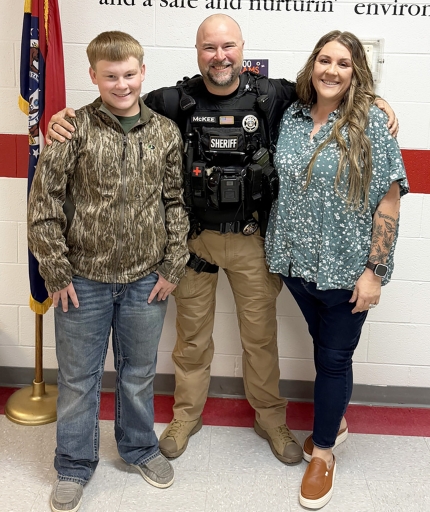
Ozark County Sheriff’s Reserve Deputy Jeremy McKee is the school resource officer at Dora School, where his wife, Amanda, is a high school teacher, and their son, Jackson, is a freshman.
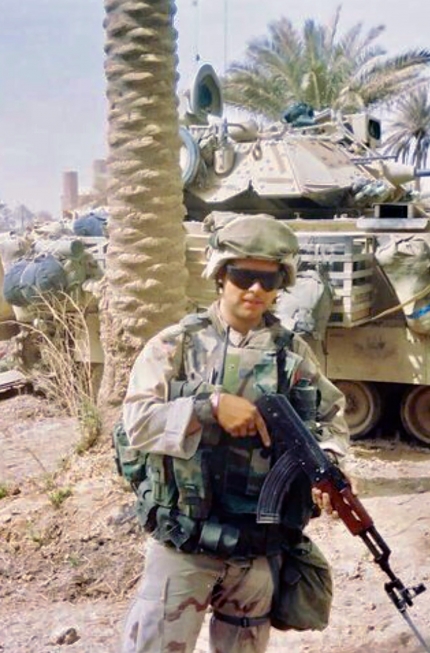
During his combat tour in Iraq, Jeremy and many of his fellow soldiers in the Army's Second Brigade, Third Infantry Division moved around the war zone inside Bradleys, the 37-ton armored and tracked vehicle shown behind him in this 2003 photo. Because of the vehicle's small capacity, the soldiers hung their gear on the outside of the Bradleys, which meant it was soon full of bullet and shrapnel holes.
It wasn't a straight and easy road to get here, but now, 22 years after his honorable Army discharge, Iraq combat veteran Jeremy McKee is in a good place in both his personal life and his career.
Happily married almost 20 years to his sweetheart, Amanda, and the father of their 14-year-old son Jackson, Jeremy is the school resource officer at Dora School, near his childhood home on the North Fork of the White River. In that important work, he's living out the adage that says, "Find a job you love, and you won't work a day in your life."
"Some days more than others, but basically, I haven't worked a day in almost a decade," he said recently.
'You get comfortable being uncomfortable'
Jeremy, the oldest of Ann and the late Myron McKee's seven children, grew up in his family's River of Life Farm, a popular resort known for its iconic treehouse lodges overlooking the river. Homeschooled, Jeremy enlisted in the Army in 1999, when he was 18. After boot camp, he served with the Army's Second Brigade of the Third Infantry Division in the Bosnia-Herzegovina area of eastern Europe as part of a NATO force tasked with keeping the peace between the formerly warring factions and facilitating reconstruction in the war-torn country, according to the Army's history.army.mil website.
Jeremy was back at Fort Stewart, Georgia, when the 9/11 attacks occurred in 2001. By mid-2002, his unit was in Kuwait for six months of desert training. Temperatures there routinely soared to 100 degrees, and the soldiers trained while carrying and wearing 50 to 60 pounds of gear each day, including ceramic-plate interceptors (first-generation bulletproof vests), 300 to 400 rounds of ammo, two canteens and a two-liter camelback full of water.
It was rough. “Everybody lost 20 pounds or so, even the skinny guys. But by the time you spend six months running, sleeping and eating in all that gear, you get used to it," he said. "You get comfortable being uncomfortable. There's some word for it – danger acclimation. You just accept it."
Jeremy's unit shifted from training to actual combat operations in March 2003, when the U.S. launched its invasion into Iraq to search for "weapons of mass destruction" that American intelligence sources said Iraqi leader Saddam Hussein was holding.
In a June 29, 2011, Times story, Jeremy described being with 5,000 to 6,000 troops staged along the Iraq-Kuwait border "as far as you could see." He and his fellow soldiers had gotten there riding in the belly of Bradleys (37-ton tracked, armored vehicles with three-man crews that can carry seven or eight combat troops).
One night, as he and fellow soldier patrolled their assigned area, “we heard horns honking, and . . . down the line, it looked like they were doing a gas drill. It was so hot, and the sand was so bad, we thought, ‘Those poor suckers, having to put on those chemical suits and masks now,’” he said. Then they saw their own guys pulling on gas masks too. "You can tell real quick when it’s a drill or for real, and we knew it was for real,” Jeremy said.
As they frantically scrambled to pull on chemical suits and masks, booms sounded in the distance. “I thought, ‘They’re gonna get us before we even get across the border,’” he said. “We suited up, jumped in the Bradleys, the engines started and the ramps were pulled up.”
Then, over the radio, came an “all clear.”
“A couple of scuds (missiles) had hit somewhere, and they thought it might be a chemical attack,” he said in the 2011 story.
The threat of chemical attack, combined with the desert's blowing sand, created a constant nightmare for the troops. "You had to keep your face clean so your gas mask would fit tight," Jeremy said.
The invasion force moved north, toward Bagdad. Riding in the back of a Bradley for several days, “we could look out the periscope and there was nothing but smoke and dust and flashes,” he said.
On April 5, 2003, several American tank companies and Jeremy's infantry company moved into the city.
“It was like a three- or four-hour drive-by shooting all the way,” he said in the Times story. “There wasn’t 30 seconds of quiet the whole time. Stuff was pinging off the sides of the Bradleys, and suicide vehicles were ramming stuff. Every kind of ordinance you could ever imagine was flying through the air."
When they finally made it through the city and could stop and dig in for some rest, they found their packs and gear, which hung on the outside of the Bradleys, full of bullet and shrapnel holes. “The squad leader told us to take all our gear off the Bradleys so they wouldn’t catch fire and burn and the smoke would blind the crew" in the next attack,” he said.
His unit spent the early summer in Baghdad and then was ordered to Fallujah. “It was sort of like the wild west there," Jeremy said.
'The long, winding road to where I am now'
Jeremy returned to Ft. Stewart in late 2003 and was discharged a year later. He came back to his family's home near Dora and helped with the family's business; in 2007, he married the neighbor's daughter, the former Amanda Naumec.
For a while, he wrestled with episodes of post-traumatic stress disorder. He’s thankful for Amanda’s support and the help of a VA-referred psychiatrist in West Plains, a former Marine who is helping him work through the PTSD challenges. He loves the life he's living now, but to stay there, he knows, "I've got to be healthy. I can't do my job if I'm not functioning. I've got to fight this stuff. Or outsmart it," he said.
“The whole reason you’re in the military is to kill people and break things. When it’s all said and done, that’s why you’re there. It’s not easy to flip that off when you come home,” he said in the 2011 story. “I don’t care how supportive your family is – and mine was – no one’s family knows how to deal with it. Unless you’ve been there, you just don’t get it.”
For a while, Jeremy floundered through a time of indecision and restlessness. "I found myself without a job, and a bunch of the service-related medical stuff was starting to manifest," Jeremy said recently. "I did the usual feeling sorry for myself."
Then he started putting those issues in perspective. "I thought, 'Hey, there's nothing holding me back now. 'Life is short, and tomorrow's not guaranteed,'" he said. Then he asked himself, "What's driving you? What's your passion? What are you serious about? What's the impact you want to make on the world?"
There was an issue that had been "a burr under my saddle" for a long time, Jeremy said. "It was the school shooting stuff. I could just never wrap my head around it," he said. "As a person and as a veteran, I thought, 'What were we supposed to be protecting if this is what is going on? Somebody should do something about it.'"
Then, "in that pigsty of moping around," he said, he heard "a still, quiet voice" in his head, asking, "Why don't you do something about it?"
Answering those questions for himself put him at a crossroads and eventually "led me down the long, winding road to where I am now," Jeremy said.
Becoming an SRO
In the next part of that "long, winding road," Jeremy connected with a West Plains business owned by fellow Dora native Greg Martin, owner of Shield Solutions LLC (shieldsolutionsllc.org) and brother of current Ozark County Sheriff Cass Martin. The company provides critical-response and firearms training for school, commercial and law enforcement personnel as well as individuals who want to qualify for a concealed-carry permit (no longer required in Missouri but needed for traveling to states where permits are required). It also provides trained security agents for business and industrial settings as well as active-shooter-response drills for schools and other settings.
"Those guys at Shield Solutions are awesome," Jeremy said. "They're big heroes of mine because they were the first guys I knew of that were training and arming school staff. Everything I've seen them do has been excellent."
Jeremy completed training at the company and came away feeling confident that he understands how corporate and school security works "and who the players are," he said. He then worked for Shield Solutions in providing industrial security at an area facility for a couple of years.
When Cass Martin took office in 2021, Jeremy got the opportunity to do the specific thing he had wanted to do since hearing that "still, quiet voice" in his head a few years earlier. When he mentioned school security to the sheriff, Martin told him he liked the idea of having deputies as school resource officers.
"I'm in," Jeremy told him. "I'm totally in."
After Martin replied that a sheriff's training academy was starting in West Plains the next month, "I ran home and told Amanda, 'Hey, big news! Long-story short, I've got to figure out how to get into the sheriff's academy next month in West Plains."
Amanda, who Jeremy says is "way more organized" than he is, "got on the computer and figured out how to apply," he said. "She gave me a checklist of things I had to do to qualify."
Greg Martin helped him with some of the pre-qualifications, Jeremy said, "and the stars were lining up."
While he continued to work full-time in his security job, he attended academy classes at the Missouri State University-West Plains campus, mostly on nights and weekends, and graduated from the 10-month program in 2022. He immediately joined the Ozark County Sheriff's Department as a reserve deputy, and the Dora School hired him as its first SRO. He completed additional resource officer basic training in Jefferson City and directed the adding of new security measures and protocols at the school.
"We got plugged into the sheriff's office network computer-wise and did assessments to figure out what we needed," Jeremy said. Then the school got a grant to provide more secure fencing, gates and locks for the campus, as well as "big trauma kits" for each of the school's halls. Better communication equipment was added, he said, and an additional automated external defibrillator for heart-related rescues was installed.
Dora School's security is especially important to Jeremy because his family is there every day. Amanda is a high school teacher at Dora, and their son Jackson is a freshman. So Jeremy is vigilant, always looking for ways to improve school security and sharpen his own skills. He is now part of the Sheriff's Enforcement Team (SET), Ozark County Sheriff's SWAT-like group of law enforcement officers with special training for high-risk search-warrant service, extreme-emergency situations and "just about every possible scenario," he said.
Qualifying and training for SET, now 45, "just about killed me," Jeremy said. "When I got out of the academy, I felt great. I thought, 'Hey, I'm pretty good; I'm in the top 10 percent.'" Then he started the SET training and "it flipped 180 degrees. I was barely keeping up." The other SET members, most of them younger deputies, "drug me through parts of it," he said. But now, looking back, he appreciates the camaraderie they developed, and he sees how the physical challenges were worth it. "Being around hard-chargers like that opens up a whole other level of awareness. It's like iron sharpens iron. It's been a phenomenal asset for what I do as a school resource officer."
Jeremy has gained a lot of new abilities and skills in his journey to become a school resource officer. But the hardest change for him may have been more mental than physical, and it involved something not everyone would understand. It was the challenge of that first day on the job, when he "standing on one side of the cafeteria knowing I needed to get to the other side," he said.
The problem? The cafeteria was filled with young elementary students at the time, and "everybody was sneezing and coughing, and the elementary kids love to slap five with everyone. But I know where those hands have been," said Jeremy, who admitted to being a "barely functioning germaphobe" when he started as an SRO. That day, he said, "I'm like, well, nobody lives forever, and I worked really hard to get here." So he walked through the tables of youngsters and "slapped fives all over the place."
Overcoming his fear of germy-hand slap-fives was kind of like being back in Iraq in that "danger acclimation" mode, where you become "comfortable being uncomfortable," he said. But those days are over; Jeremy's germaphobia is gone.
"Now," he said, "I practically go around licking doorknobs."
'Find something meaningful'
Jeremy has been through some hard times and difficult challenges, but now, he says, he wouldn't want to be anywhere else. "If anybody's at a crossroads wondering where to go or how to make their lives make sense, I would tell them to find something meaningful to you, like I did, then commit to it and let it drive you," he said. "I wish somebody had told me during some low spots where my life was going to end up. That would have been a heck of a shot in the arm."