
Ozark Countian’s 1937 hanging was last public execution in Missouri
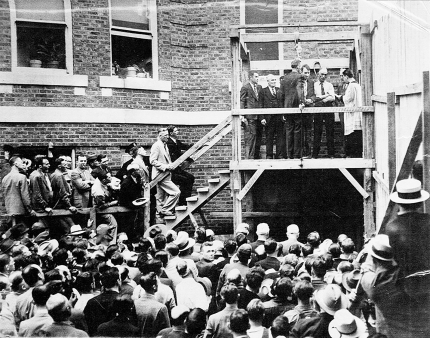
Howard’s Ridge native Roscoe “Red” Jackson is pictured on the gallows platform with a noose around his neck shortly before his May 21, 1937 death, carried out by public hanging in Galena.
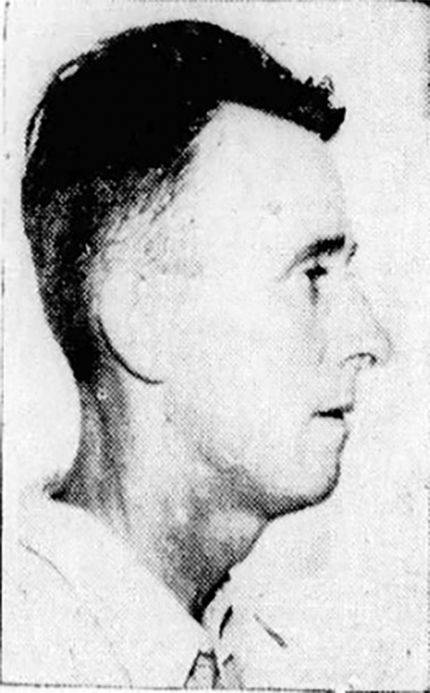
Roscoe “Red” Jackson
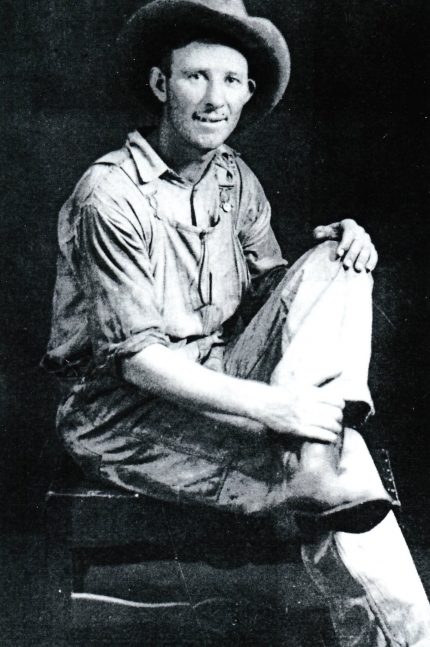
Roscoe “Red” Jackson grew up helping his parents on their Howard’s Ridge farm. Early photos of him show him in overalls and work boots.
Editor's note: This article was printed in the Oct. 21, 2026, edition of the Ozark County Times. Subscribe to the Ozark County Times here to have a newspaper mailed to your home or delivered to your inbox each week: www.ozarkcountytimes.com/ozark-county-times-subscriptions.
As part of a nationwide debate as to whether the upcoming execution of former Army Major Nidal Hasa should be broadcast live for the public to watch, many news reports point to 1936 as the year of the last public execution in the United States. But those accounts failed to mention that a year later, Ozark County native Roscoe “Red” Jackson was hanged before a public crowd in Galena, Missouri, in an execution that was very public at the time but has received far less attention in modern accounts.
And while his end is noteworthy, the history that led to the gallow is also worth remembering. Jackson’s life took him from a log cabin near Howard’s Ridge to the oil fields of Oklahoma, through years of trouble with the law and a final attempt to return to the Ozarks which ended in a murder conviction and ultimately his death.
His story, preserved in old newspaper accounts from the 1930s, offers a glimpse into a different era of crime, punishment and public attitudes toward justice.
A boy from Howard’s Ridge
Roscoe Jackson was born May 11, 1901, in a log cabin on Liner Creek near Howard’s Ridge, south of Gainesville. He was the oldest son of Andrew J. and Matilda Jackson and grew up working alongside his father on the family farm. According to a 1937 account in the Stone County News-Oracle, Red left home at age 17 and drifted west. His family eventually lost track of him as he made his way into the oil fields of Oklahoma.
He married Donna Ellison, an orphan who had also been raised near Howard’s Ridge, and the couple had four children. By the time Red’s life reached its final chapter, however, he and his wife were estranged, and she and their children were living in Pauls Valley, Oklahoma.
His first known brush with the law came as a teenager after a dispute with another boy over a girl. According to a 1985 historical essay by Bizzy Brown in the White River Valley Historical Quarterly, Red began carrying a concealed gun after getting into the fight with his rival. He was arrested sometime after the fight with the hidden weapon and was charged with felonious assault and carrying a concealed weapon. The assault charge was eventually dropped, but Red pleaded guilty to the weapons charge and was sent to the state penitentiary for two years. He was represented by attorney G.W. Rogers of Gainesville.
Red was later paroled but violated his parole and fled to Oklahoma. Ozark County Sheriff Walter Endicott brought him back to Gainesville, where G.W. Rogers represented him in court again. The attorney reportedly reached an agreement with the judge that kept Red from being sent back to prison. But, in 1925, after yet another parole violation, the court chose to terminate the parole and send him to the penitentiary.
Burning a dog alive
Another incident from Red’s early years also followed him into the newspapers. In May 1926, the Douglas County Herald reported that:
“A dastardly crime, of which a dog was the victim, was perpetrated by prisoners in the Ozark county jail at Gainesville, one day last week. The prisoners are said to have called the dog to the jail door, and reaching thru the bars, held the animal while they saturated its body with coal oil and then set it off with a match.
“The flaming animal, crazed with fright and pain, ran yelping thru the streets and created considerable excitement before it ran under a porch at the Hamilton hotel, where merciful citizens relieved its suffering by shooting it to death. The dog set fire to the hotel, but it was quickly extinguished before any damage was done.
“The crime is alleged to have been the work of Roscoe Jackson, who was sentenced to the penitentiary more than a year ago on a charge of carrying concealed weapons. He was paroled, but recently broke his parole and was taken back to the penitentiary last week by Sheriff Endicott.
“[Red] is said to be about 25 or 40 years old and has a family. He was working on the highway work in Ozark County at the time he was sentenced to the penitentiary. No motive is given for the extreme cruelty to the dog.”
However, the 1985 historical essay by Bizzy Brown in the White River Valley Historical Quarterly, said another prisoner, identified as Claude Tackett, had actually set the dog on fire and Red offered to take the blame, apparently believing he would be sent back to prison anyway. Brown noted that her piece was written based on conversations she had with the honorable Clyde Rogers, son of General Washington (G. W.) Rogers, Red’s defense attorney throughout the years. Brown said Rogers allowed her access to his father’s file on Red. In addition to the attorney’s records, Brown said she also used personal recollections of Frank “Skeeter” Stevens, son of Ozark County Sheriff Lyman Frank Stevens, who was in office during the 1920s and 1930s.
The conflicting accounts leave some uncertainty about Red’s exact role in the horrific event, but whether he was responsible or just took the blame, the episode became part of the man’s violent reputation and forever a part of the public record surrounding his life.
A ride that ended in murder
In 1934, Red was living in Oklahoma when he began making his way back toward Ozark County. Along the way, he met Pearl Bozarth, a traveling salesman from Evansville, Indiana, who sold poultry remedies.
The Stone County newspaper explained: “Bozarth, who spent part of his time on the road selling his products, picked up Jackson, a hitch-hiker, on the road from Springfield to Forsyth. He hauled him into Forsyth, paid for his meals and a night’s lodging and the next morning started out with him from Forsyth to Ava. Jackson had told him he was trying to get to his ‘folks’ in Ozark county. Just west of Brown Branch, in the northeast corner of Taney county, Jackson shot the man who had befriended him, threw his body on a side road exposed to the August sun, took his car and drove away.”
Body found two days later
The body was not discovered right away, although it is thought that a neighboring farmer heard the gunshots that caused Bozarth’s execution-style death but was ignorant to its origin and did not investigate until discovering the grisly scene by accident two days later.
The Springfield News-Leader reported: “The mid-morning quiet at August Schultz’s farm, near Brown Branch, in Taney county, was broken late last week by the thundering of a revolver. Hearing two shots less than 200 yards away was an unusual occurance, but the aged farmer paid little attention, in fact, so little attention that he can not now recall whether the shooting took place Thursday or Friday.
“No doubt Schultz, middle-aged and husky, would have been more impressed, had he known the gruesome discovery he was to make at noon Saturday. Walking into a lonely byroad that runs off the highway, to serve as a boundary for his land, Schultz’s eyes fell upon the body of a well groomed, gray-haired man who had been shot twice through the head. Papers in a pockets of his neat business suit identified the victim as Pearl L. Bozarth, 53, of St. Louis, owner of a large poultry medicine manufacturing concern and father of Mrs. C. W. Glassen...
“Mystery last night cloaked the entire case, save for evidence the man had been slain by robbers. Bozarth, noted for carrying large sums, had only 95 cents when his clothes were searched by Coroner Bob Thornfill. His expensive watch had been left behind, with identification cards and a price list of poultry tonics, no doubt because of its tell-tale serial numbers. A slip, bearing the name of a Minnesota tourist camp, was in the shirt pocket.
“Tire tracks in the soft earth indicated to Sheriff W. L. Pumphrey that the victim had been driven off the main highway up the byroad a few hundred feet, and that the car had been backed out to highway 78. The car is believed to have been Bozarth’s...”
Investigators began piecing together the events leading to Bozarth’s death. Witnesses in Forsyth remembered seeing the salesman with a hitchhiker. Others recalled a man wearing black-and-white shoes, and a filling station attendant remembered the hitchhiker helping gas Bozarth’s car.
Red was identified as the man who had arranged to ride with Bozarth. Investigators learned he had a girlfriend in Oklahoma and began watching her home. That search led them to Red, who was arrested in Oklahoma while in possession of Bozarth’s car.
The automobile had been altered to disguise it. What had been a gray Dodge coupe was now painted black with a paintbrush, and changes had been made to its radiator cap, wheels and other features.
Investigators found evidence connecting Red to the paint and brush used to change the car’s appearance, along with a gun and other items.
According to Brown’s historical account, Red described the killing to authorities during his return to Missouri. He said he had ordered Bozarth to stop, demanded his money and followed him away from the car. When Bozarth turned and tried to knock away the gun, Red said he shot him. He then took the money and car and headed back to Oklahoma. It was near Pauls Valley that he repainted the car and left the Ram from the radiator cap and sidemounts.
Red was returned to Missouri by authorities and held in the jail at Ava while awaiting trial. At the time of his arrest, authorities also linked Red to the murder of another man, Osie Garrison, in Pauls Valley, who they said Red was either gambling with or attempting to rob when he shot and killed him.
An escape and a second chance
Again, G. W. Rogers was hired to represent Red on the local charge, and he worked out a plea agreement with the Taney County prosecutor under which Red would plead guilty in exchange for a life sentence in the state penitentiary.
But, before the case could be resolved, Red threw a wrench in the negotiations and escaped from the Ava jail. The Oct. 11, 1934, Ozark County Times reported that: “Roscoe (Red) Jackson... sawed a bar from his cell window and escaped on Monday night of last week. Jackson is believed to have been supplied a hack saw by a fellow prisoner who had just been released from jail. He is believed to have made his getaway on foot.”
He was recaptured in West Plains a few days later after officers stopped Red, who was accompanied by a Gainesville man named Norman Carter, at a filling station near the town of Hocomo, 17 miles south of West Plains. Local news reports said that officers followed the car for miles before Red and his passenger finally stopped at the filling station.
He was re-arrested, and the escape cost him the plea agreement and ultimately the life sentence.
The case was moved from Taney County to Stone County on a change of venue motion, and the trial was held in Galena in December 1934.
Red maintained a different account of Bozarth’s death during the trial. He claimed another hitchhiker had shot Bozarth and then forced him to drive Bozarth’s stolen car to Oklahoma. Red said the other man eventually gave him the car, which is why he had it when officers caught up with him.
The jury found Red guilty of first-degree murder but could not agree on a punishment. According to the Stone County News-Oracle, which covered the trial, nine jurors favored the death penalty while three favored life imprisonment. “The jurors told the judge it would be impossible for them to agree on the sentence, so the jury was discharged and Judge Gideon assessed the death penalty,” the news article read. “Jackson received the sentence calmly and was taken immediately to the county jail to await transportation to Jefferson City where he will be placed in ‘Death Row’ to await the date of his execution.”
It was reported that almost immediately after receiving the death sentence, Red asked to be taken to the river to be baptized. The News-Oracle said the request came late in the afternoon, but Stone County Sheriff Seth Tuttle said it “was not within his province to deny a man the benefit of baptism.” And Red was taken to a nearby river where Rev. Whittenburg, pastor of the Christian church, performed the ceremony. Guards were stationed along the river bank to help prevent an escape attempt. Red was led to the water where the sheriff removed his handcuffs because he said he did not believe any man should be baptized with handcuffs on. The minister performed the ceremony and returned Red to the sheriff’s custody. Red was said to give no trouble or attempt to escape and addressed those in attendance saying, “I’m going with a clear conscience. I’ve made peace with God.”
After that, Red was sent to the state penitentiary in Jefferson City while his case underwent review. The hanging was set for Feb. 18, 1935, just a few months after the trial. However, his attorney filed an appeal to the supreme court, which was granted. That pushed back the execution date until the court could review the case.
While they awaited the supreme court’s decision, Red was placed in solitary confinement in the prison’s death cell as attorney Rogers continued efforts to have his sentence changed to life imprisonment. He remained in solitary confinement for nearly two and a half years (29 months). The supreme court took up the appeal in March 1937 and affirmed the conviction and death sentence.
After his conviction, Red confessed to Bozarth’s murder, according to the News-Oracle. The newspaper also reported that he confessed to killing the other man in Oklahoma shortly before his arrest, likely Garrison. Brown’s essay said Red told Sheriff Frank Stevens on the eve of his execution that he had committed three other murders.
A push back from Stone County
Under Missouri law at the time, executions had to take place in the county where the trial was held. With his appeals exhausted, Red was returned to Galena for his hanging.
Meanwhile, there had been a movement in Stone County opposing the upcoming hanging. “People of Galena are decidedly against the execution of Jackson in Galena. They believe he should have been hanged in Taney county, since the crime was committed in that county. Nobody in Stone county is interested in the case, and his hanging here will only be a blot on the county and unpleasant memory for a lot of people,” the News-Oracle reported.
Sheriff Tuttle was reported to have been uneasy in the last two years of his term awaiting to see if he would be required to spring the trap to the gallows and send Red to his death. But, the supreme court decision came three months after he left office. He publicly expressed relief that he was not responsible for the grisly task.
In his place, new sheriff I. H. Coin had taken office and didn’t share the same concerns as Sheriff Tuttle. Sheriff Coin told the local newspaper, “I had just as soon hang Jackson as to hang a yellow dog. He took the lives of two men in cold-blooded murder, and it won’t bother my conscience at all to spring the trap for him.”
After the supreme court’s decision, Sheriff Coin sought instruction from Jefferson City about the process of building the gallows where Red was to meet his end. He ordered the lumber and had it delivered to the Stone County courthouse lawn and gathered a group of men to assemble the wooden structure for the planned execution date of April 23, 1937; however, he received word the week before the trial that Missouri Governor Lloyd C. Stark granted Jackson a reprieve until May 21, 1937, in order to give him time to study Red’s case, along with two other men who were set to hang that day in other parts of Missouri.
The reprieve gave many Stone County residents hope that the execution wouldn’t be carried out in their town, but it just seemed to vex Sheriff Coin, who was “rather up in the air about his plans to proceed with the erection of the scaffold. He doesn’t know whether the Governor will grant another reprieve or whether the sentence will be commuted to life imprisonment. The sheriff has invested his money in lumber for the scaffold and the stockade, and it is piled up on the court house lawn. He says he wishes the Governor had granted the reprieve before the lumber was purchased because some of it is certain to warp and ruin before time to use it.”
By May 19, the governor decided not to grant further reprieve and upheld the decision that Red would die at the gallows in Galena on May 21.
A crowd gathers in Galena
Red arrived late Thursday afternoon, May 20, 1937, after being brought from the penitentiary in Jefferson City. His father, Andrew J. Jackson, traveled from Howard’s Ridge to see him, accompanied by the Rev. Sterl A. Watson, a Church of Christ evangelist and family friend.
The elder Jackson, then 64, had not seen his oldest son in about 10 years. The Stone County News-Oracle described him as a kindly, physically impaired man who waited in Galena while preparations were made for the execution.
Red chose Father Michael Ahern of Springfield to accompany him during his final hours. He embraced Catholicism while in prison, a decision his father, a devout Church of Christ elder, reportedly found difficult to accept.
The father and son met at the jail for about two and a half hours. Jackson told his father and Watson not to worry about him and said he was prepared to meet his fate. His father and Watson left Galena later that night to prepare for the funeral. Red’s father decided he would not witness the hanging of his son.
Meanwhile, crowds began arriving in Galena. While the prospect of a legal hanging had unsettled many residents, some of whom planned to leave town rather than witness it, others felt the law had to be carried out, even though most said they dreaded what was coming.
By early Friday morning, May 21, people filled the square and pressed toward the enclosure surrounding the gallows. Tickets to watch the execution were granted to 400 people. The News-Oracle estimated that all of those with tickets came and were inside the enclosure, with perhaps as many or more waiting outside. A report in the West Plains Weekly Quill estimated the non-ticketed crowd outside the enclosure to add about 200 spectators. The Cassville Democrat even printed a photo of hopeful viewers climbing trees outside the area to try and gain a higher vantage point in order to witness the event.
The execution had become a regional spectacle, drawing law enforcement officers, newspaper reporters, photographers and curious onlookers from across the Ozarks. And while many found the day to be of heavy hearts, not everyone treated the occasion solemnly. The News-Oracle later criticized those who turned the night before the hanging into a time of revelry, including police officers who drank heavily while in town for the hanging.
“One of the most disgusting things in connection with the execution was the attitude of some folks who came to Galena the evening before or during the night immediately before the hour set for execution. While some of them conducted themselves in a way befitting the occasion, others considered it a time for merriment and made a sort of Roman holiday out of it.
“And the surprising thing about it was that some officers, sworn to uphold the law and who should have realized the seriousness of the situation, took advantage of the opportunity to get themselves liquored up. At least one officer was thrown in jail and a prosecuting attorney from a nearby county barely missed being locked up when some of his friends hid him from the local officers until he could sober up.”
The Springfield News-Leader also reported that “Visitors from other cities, especially from Springfield, caroused throughout the night with the merriment getting louder toward morning. Drink flowed freely and several fights occurred and mechanical music boxes played loudly and raucously the latest swing tunes, and the visitors celebrated the doom of a man who also had killed. The loud laughter and frequent boisterous oaths penetrated into the county jail, where the condemned man was seeking solace in his last hours...the convention-like spirit and the morbid and ghoulish delight with which many greeted the hanging failed to in anyway break the iron composure of Jackson.”
The newspaper questioned the lesson such behavior offered at an event intended to demonstrate that crime carried consequences.
‘A man reaps what he sows’
Shortly before 6 a.m., Jackson was led to the scaffold by Father Ahern and a group of officers. He wore a dark suit, white shirt and striped tie. After climbing the steps, he faced the crowd and spoke through a window in the enclosure. “Folks, not everybody realizes what it is to die,” he began, according to the News-Oracle.
He spoke about the difficulty of knowing death was coming, a reference to the long months he had spent alone in confinement waiting in prison. He acknowledged that he was the center of the day’s attention and asked those who believed in prayer to pray for him. “I am leaving without any ingratitude in my heart toward anyone,” he told the crowd.
The newspaper reported that Jackson remained calm throughout the proceedings. Officers placed a hood over his head, secured the noose around his neck and fastened his legs. With his hands raised slightly, Jackson offered a final farewell.
“Well, be good, folks.”
Sheriff Coin then pulled the lever, and Jackson dropped through the trap. The News-Oracle reported that the lever was pulled at 6:03 a.m. and Jackson was pronounced dead 10 minutes later.
He was 36 years old.
Among those watching was Howard Bozarth, Pearl Bozarth’s son, who had traveled to Galena to see the man who killed his father face his sentence.
Brown’s account said that after the execution, Taney County Sheriff Henry Simmons cut the noose into pieces and handed them out as souvenirs, a practice she described as being in poor taste.
The public fascination did not end when Jackson’s body was removed. The newspaper reported that curious visitors continued traveling to Galena over the following days to see the gallows. Schoolchildren on picnics even stopped to look at the site.
The last hanging in Missouri
Red’s body was taken to Crane to be prepared for burial. His family could not afford the expenses, and the county initially agreed to pay the $25 allowed by law. Friends, including Rogers, contributed additional money so the body could be returned to Ozark County.
The body arrived at Howard’s Ridge on the afternoon of May 21. Funeral services were held the following day, with Watson officiating. The Ozark County Times reported that many local residents attended. Jackson’s parents, brothers and sisters attended. His estranged wife and their four children, still living in Oklahoma, were not expected to be there.
Jackson was buried in the small cemetery at Howard’s Ridge, near the community where he had been born and raised. His grave remains in the cemetery, located on County Road 526 off J Highway, a quiet marker of a man whose life and crimes once drew crowds and headlines across the country.
Red’s hanging was one of two final legal hanging in Missouri, both of which occurred on May 21, 1937. The other individual hung was Dudley Barr, an African American man who was convicted for his role in a fatal armed robbery and was hanged at the Jackson County courthouse in Kansas City. A new state law providing for execution by lethal gas had been approved shortly before their deaths, replacing hanging and moving executions to the state penitentiary in Jefferson City.
More than 89 years later, public executions are again part of the national conversation. For Ozark County, Jackson’s story is a reminder that national history sometimes has a local chapter. The man who climbed the gallows steps before a crowd in Galena began life in a log cabin on Liner Creek, worked beside his father on a farm near Howard’s Ridge and was ultimately brought home to rest in the community where his story began.