
Restoration brings the old Bank of Gainesville back to its 1920s glory
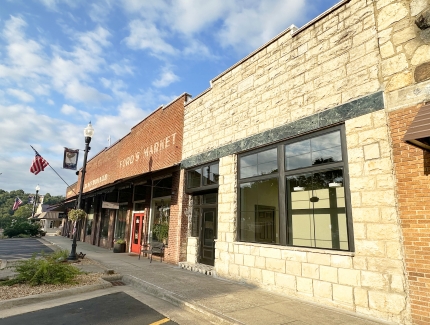
The light stone building on the west side of the Gainesville square has recently been renovated, taking its inspiration from its history as the Bank of Gainesville location in the late 1920s.
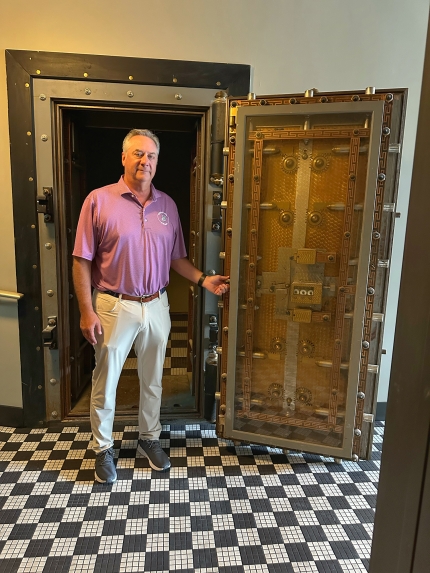
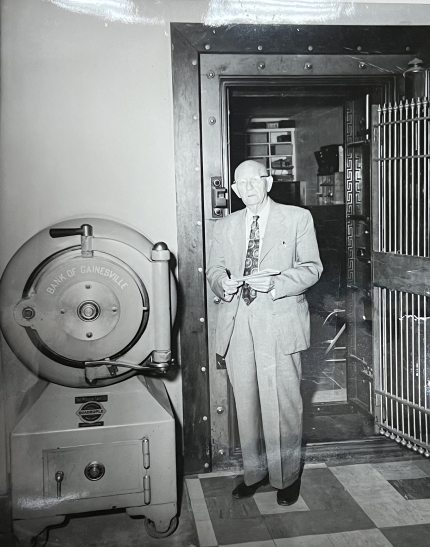
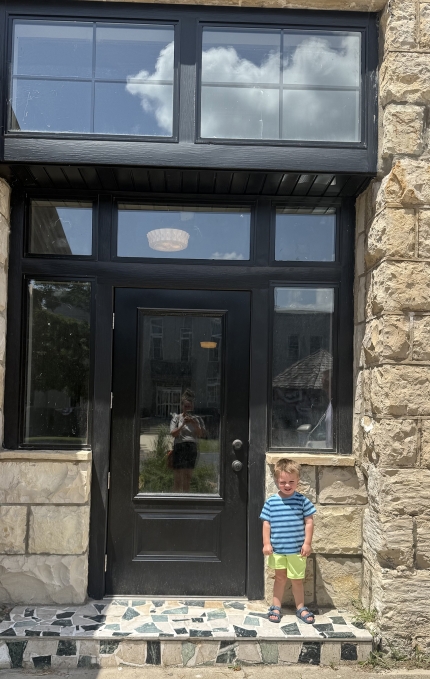
Left: Century Bank of the Ozarks CEO Chris Harlin, who spearheaded the recent renovation of the old Bank of Gainesville on the west side of the square, stands in the same spot as his great-grandfather Johnny Harlin in the photo on the right.
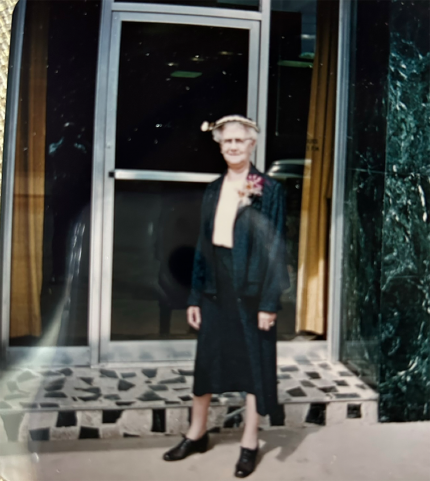
At left, Clara Harlin poses for a photo sometime in the 1960s. At right, Clara’s 2-year-old great-great-grandson Brooks Martin, son of Abbi and Alex Martin of Fayetteville and grandson of Chris and Missy Harlin, stands in front of the newly restored bank building.
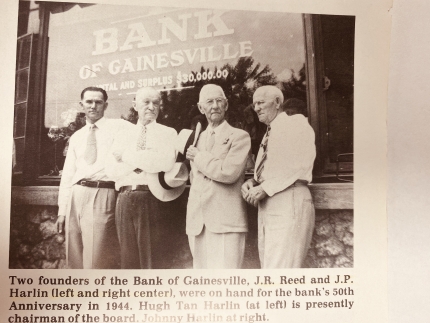
Hugh Tan Harlin, J.R. Reed, J.P. Harlin and Johnny Harlin were on hand for the bank’s 50th anniversary in 1944.
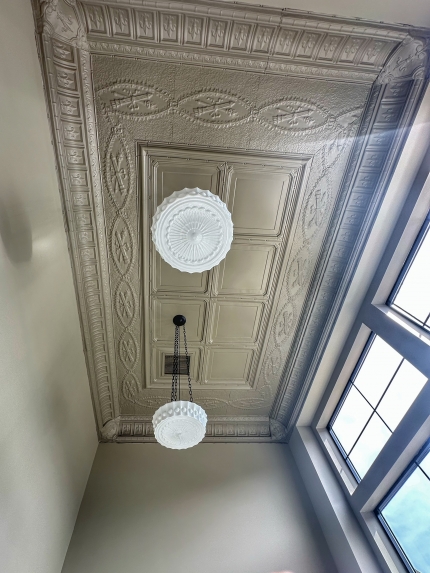
The original pressed tin ceilings were too damaged to salvage, but enough remained to provide a pattern for a new ceiling, which now looks as it did in 1927.
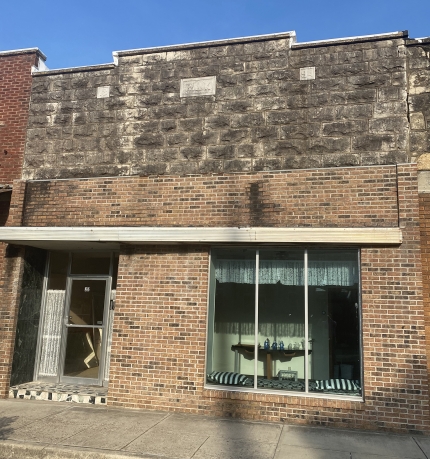
Above is how the old Bank of Gainesville looked when the bank was repurchased in 2020. The brick was installed sometime in the 70s or 80s after the green marble that was installed in the 1950s began pulling away from the building.
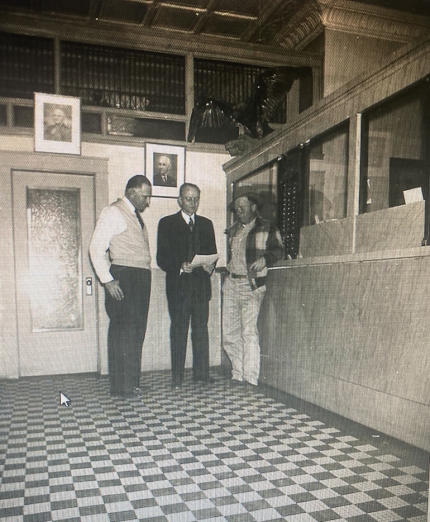
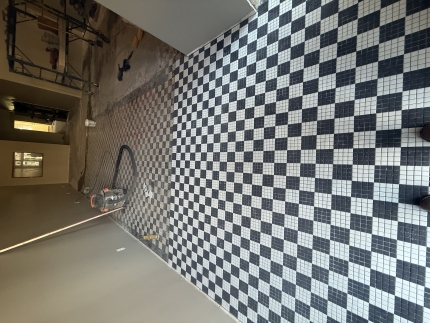
Recreating the appearance of the original mosaic tile was an important part of the old bank restoration. Above: Hugh Harlin, ET Brown and Ray Wallace are pictured sometime in the 1950s. Below: You can see how closely Randy and Josh Dalton, who were the contractors for the project, were able to match the new floor to the old.
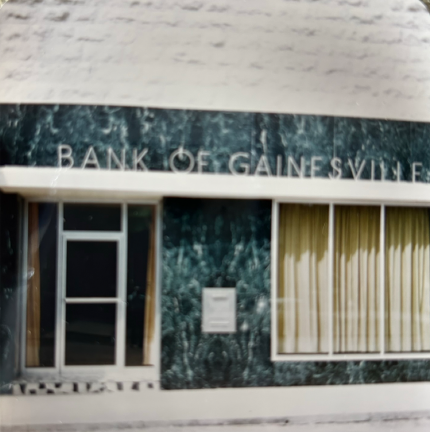
The brick was installed sometime in the 70s or 80s after the green marble, that was installed in the 1950s began pulling away from the building. The photo on page 1 shows the restored building. Look closely and you can see a bit of the green marble was incorporated in the design.
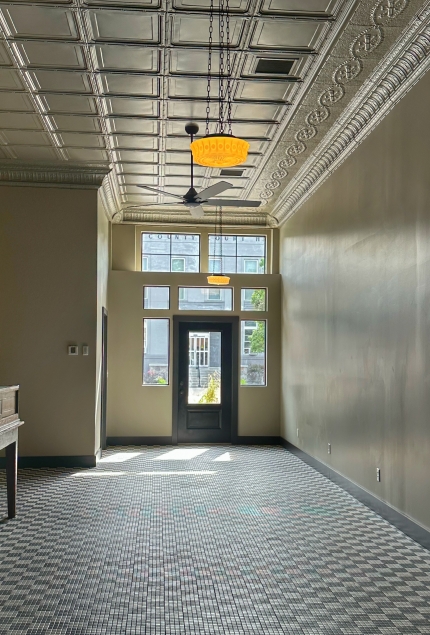
The newly restored Bank of Gainesville building on the west side of the square looks almost exactly as it did when the bank moved in the late 1920s, thanks to the efforts of Chris Harlin and contractors Randy and Josh Dalton.
For more than a century, the sturdy rock walls of the old Bank of Gainesville have watched Gainesville’s square change around them. Modern conveniences replaced some of the building’s original features, and layers of renovation eventually concealed much of the craftsmanship that gave the building its character.
Now, after nearly 10 decades of changes, the old bank is once again showing its original face.
Chris Harlin, CEO of Century Bank of the Ozarks, said the building on the west side of the Gainesville square was repurchased in 2020. Their goal was not to modernize the historic structure, but to turn back the clock, restoring it as closely as possible to the way it looked when the Bank of Gainesville moved into the building in the late 1920s.
That work is now complete.
“We’re not sure what we’ll do with the building after that, but for now, we want to restore it as best as we can,” Harlin said when the project began.
The result is a building that once again reflects the elegance of its early years, including its rock exterior, black-and-white tile floor and pressed-tin ceiling. Tucked inside are reminders of an even earlier chapter in the bank’s history.
From a wood-frame building to a landmark
The story of the Bank of Gainesville began July 24, 1894, when the bank opened for business in a small wood-frame building on the west side of the square with $5,000 in capital.
One of the bank’s earliest pieces of equipment was a massive cannonball safe, which was hauled from West Plains to Gainesville by a team of horses belonging to Joe Farmer.
The July 5, 1894, edition of the Ozark County News reported on the accomplishment: “The officers of the Bank of Gainesville complimented Joe Farmer Saturday evening on the pulling qualities of his team of horses.”
The newspaper noted that the safe, wagon and framing weighed between 4,400 and 4,500 pounds. “There are few, if any, other teams in the county that would have drawn the load,” the newspaper reported. That safe would remain a part of the bank’s history for generations.
In 1927, the Bank of Gainesville moved next door into the larger building that is now being restored. The new bank featured a rock exterior, solid marble teller cages, a black-and-white mosaic tile floor and a pressed-tin ceiling — all features that reflected the stately style of commercial buildings of the era.
The building remained home to the Bank of Gainesville through the late 1960s.
A 1950s makeover
Like many older buildings, the bank eventually received a modernization.
In the 1950s, Harlin’s grandfather Hugh Tan Harlin remodeled the building, adding what were then considered modern conveniences and a more contemporary appearance.
The rock exterior was covered with a green marble facade. Inside, the pressed-tin ceiling was hidden beneath acoustic ceiling tiles so ductwork could be installed for air conditioning. The original tile floor was eventually covered with laminate and later carpet.
Years later, the green marble facade began pulling away from the building. It was removed, and sometime in the 1970s or 1980s, brick was installed over the original rock.
That brick front remained until the latest restoration.
For Harlin, however, the 1950s remodeling eventually led to one of the most exciting discoveries in the project.
“Back when I first bought it, I wondered what was above that dropped ceiling, so I took a broom and broke through and saw that beautiful pressed tin ceiling,” Harlin said. “I thought we would just take down the panels and expose it, but it was too damaged.”
Years of alterations had damaged the original tin beyond simply removing the acoustic tiles and putting it back into use.
But there was enough of the original material remaining to provide a pattern.
Recreating a ceiling from the past
Harlin turned to the W.F. Norman Corporation in Nevada, Missouri, a company that has been producing pressed-tin ceiling tiles since the late 1800s.
Using pieces of the old ceiling as patterns, the company was able to manufacture new pieces that replicated the original design.
What had been hidden for decades was once again made a prominent feature of the building.
The restoration team also tackled the original black-and-white tile floor.
The original mosaic flooring had been covered first with laminate and later with carpet. Randy and Josh Dalton of Ava, who handled much of the restoration work, were able to recreate the appearance of the original floor so closely that it is difficult to distinguish the restored portions from the original.
Outside, the work required peeling away decades of changes.
The Daltons removed the brick that had covered the building, exposing the original rock face underneath.
Some of the original rock had been removed during the 1950s remodeling, so the entire facade could not simply be uncovered and left untouched. Missing sections were restored so the building once again closely resembles its 1920s appearance.
A little bit of the 1950s remains
Although the goal was to return the building to its earlier appearance, Harlin didn't want to erase every trace of its history.
He remembered stacks of the green marble that had been removed during an earlier renovation and stored at his grandparents’ house.
Some of that marble remained.
When the restoration revealed an unattractive strip of concrete block, Harlin saw an opportunity to preserve a small piece of the building’s more recent history.
“I thought, I’ll get some of that green marble, put it on there and we’ll have a little bit of the ’50s look in with the old,” he said.
The marble was taken to Rob Collins, who polished and cut it for installation.
It now provides a small visual reminder of the building’s 1950s chapter amid the restored 1920s design.
A family connection
The restoration is particularly meaningful to Harlin because the building is tied closely to his family’s history.
The Harlin family owned the old bank building from 1927 until 1995, even after the bank moved to a new location in 1969.
For years, the old building was used by various renters and eventually as storage.
The bank itself had moved to its present location on the northeast corner of the square in 1969. Construction of the new facility was reported in the Ozark County Times in February of that year.
That building has since been expanded several times and now includes a second building connected to the original facility by a skywalk.
The bank became Century Bank of the Ozarks in 1996 after acquiring Douglas County National Bank in Ava.
The old building was sold in 1995.
Looking back, Harlin admits he regretted letting the property go.
“And you know, I always kind of regretted it,” he said.
When the opportunity came to purchase the building again in 2020, he was thrilled.
“We knew that we wanted to do something with it at some point, but it took a while to get to it,” he said.
The treasures inside
Perhaps the most tangible connection between the bank's earliest days and its present-day restoration is the old cannonball safe.
The safe had been housed in the original bank building since the bank opened in 1894 and was moved next door when the bank relocated in 1929.
It remained inside the old bank’s vault for decades.
When the building was repurchased, they moved the historic safe to the lobby of the bank's current facility.
The move marked the first time the massive safe had been outside the old building since 1929.
The old bank building still contains its original 1920s vault and vault door — another piece of history that survived the decades of changes.
Together, the vault, safe, tile floor, rock walls and pressed-tin ceiling tell the story of a Gainesville institution that has been part of the community for more than 130 years.
Preserving more than a building
The old bank restoration is the Harlin family's second major historic preservation project in Gainesville.
Their first began in 2001, when the family purchased and renovated the grand three-story home on Harlin Drive built in 1912 by John C. and Clara Harlin, John Harlin's grandparents.
That home, now listed on the National Register of Historic Places, was once operated as the Old Harlin House Café, Splendid Graze and is now owned by Mike and Heather Gardner, who rent it out for events such as weddings and family reunions.
The restoration of the old bank follows that same philosophy: preserve the past rather than simply replace it.
For Harlin, the building is more than an old commercial property.
It is a physical connection to the family's history, the bank's history and Gainesville's history.
What happens next inside the building has not yet been decided.
“We may bring some bank memorabilia over,” Harlin said. “We may do some small bank events. We’ve tossed around several ideas, but haven’t decided on anything yet.”
Whatever its next chapter may be, the old Bank of Gainesville has already regained something that seemed destined to disappear beneath decades of modernization.
The rock walls are visible again.
The black-and-white floor has returned.
The pressed-tin ceiling is once again on display.
And the old building — which began its life as a bank nearly 100 years ago — once again looks much like the landmark Gainesville residents of the 1920s would have recognized.
The restoration doesn't turn back time.
But it does something nearly as valuable: It makes sure Gainesville can still see it.