
Vietnam veteran Les Wells' family has a strong Navy history that includes his WWII veteran mother and her twin sister
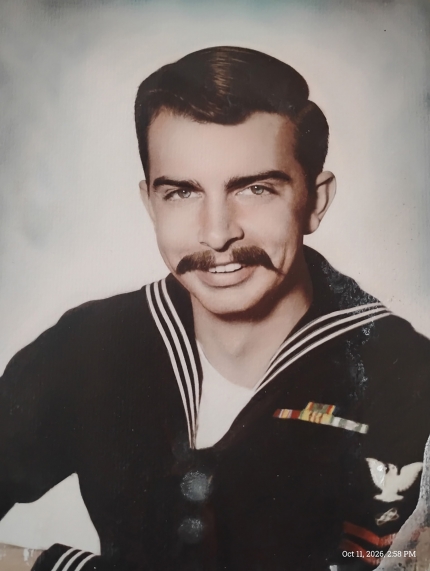
Isabella-area resident veteran Les Wells served in the Navy from 1968 until 1973. His tour included 34 months on ships in the combat zone off the coast of Vietnam.
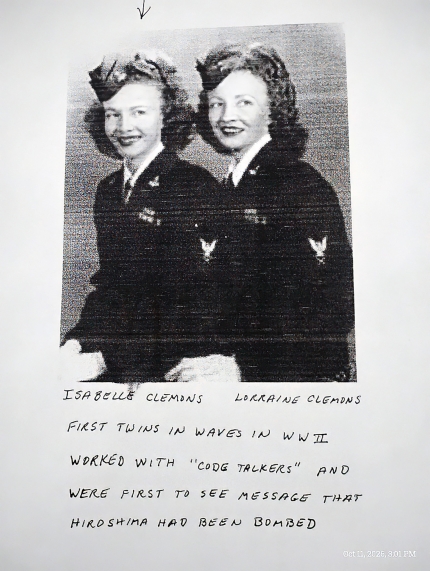
Les Wells says his family has a strong naval history. It includes his mother, Isabelle Clemons Wells, and her identical twin sister Lorraine, who enlisted in the Navy in December 1941 immediately following the Japanese attack on Pearl Harbor.
Isabella-area veteran Les Wells says his family “has a very strong naval history. It’s in our blood.” In fact, if you do a Google search of his mother’s maiden name (Isabelle Clemons), a page in the U.S. Navy’s archives comes up showing a photograph of Isabelle and her identical twin sister, Lorraine.
They enlisted together in December 1941. (The website says they enlisted in December 1942, but Les says that’s an error.) “The main reason they joined,” he said, “was that my mom’s fiancé was one of the first casualties.”
A Navy pilot, Isabelle’s fiancé was killed in the Japanese attack on Pearl Harbor on Dec. 7, 1941. When a heartbroken Isabelle announced that, in response to her fiance’s death, she was joining the Navy, her twin sister Lorraine said she would join too. They were the first set of female twins to join what would soon become the Navy’s WAVES (Women Accepted for Voluntary Emergency Service).
“They joined in December 1941, and they were both in intelligence and communication,” Les said.
The twins worked with encryption devices in important jobs – handling military messages at a station outside Washington, D.C. During their service, they worked with the famous Navaho Code Talkers, and throughout their lives they stayed in touch with them. “When the last one died two or three years ago, we got a letter letting us know he had passed,” Les said.
The twins’ high-level intelligence communication work put them in the position to be the first ones in the nation’s capital on Aug. 6, 1945, to see the message that Hiroshima had been bombed. America’s release of the world’s first nuclear weapon there would soon bring World War II to a close.
While Isabelle was devoted to her Navy job, there came a day during her career when she just didn’t feel like going to work. “She was goldbricking. She just didn’t want to go to work that day,” Les said. “So she went to the dispensary and checked herself into the Navy hospital in Bethesda, Maryland.”
When a Navy corpsman came to give her a shot, “she admitted she wasn’t sick,” Les said. But the corpsman told her, “They sent me up here to give you a shot, and I’m going to give you a shot.”
Isabelle and the corpsman, Leslie N. Wells, were married a short time later. The oldest of their four children, Leslie C. “Les” Wells is now 78 and living in Ozark County. He grew up hearing the stories of his mom’s enlistment and how his parents met while both were serving in the Navy. After the war, Isabelle and Leslie raised their family in a remote part of northeastern Kentucky, on his paternal grandfather’s home turf in Fleming County, the “foothills of Appalacia,” Les said.
“Do you know how smart he is?”
Les was smart, all right. But he wasn’t smart enough to avoid some setbacks and poor choices in his life. After he was awarded a full-ride National Science Foundation scholarship to Vanderbilt University in Nashville, “I got to thinking I was hot stuff,” he said. “That started me away from God. It’s where I let Satan in.”
He had a serious girlfriend and thought they would spend their future together after college. But when that relationship went south, he dropped out of Vanderbilt after only one year. The Vietnam War was going on, and he’d had an exemption from the draft while he was in college, but he gave that up when he dropped out and enlisted in the Navy in January 1967.
He had hoped for training in the Navy’s nuclear power program, but while he was home on leave after boot camp, the Navy changed his training assignment from nuclear power to electronics. For the next three years or so, most of the time he was working on electronic equipment on one ship, then another, stationed off the coast of Vietnam,” he said, adding that he was supposed to be involved in the Vietnam war 11 months. Instead, “I was technically in the combat zone for 34 months,” he said.
‘Did you write this letter?’
After 18 months on the first ship, Les was transferred to a helicopter carrier hosting a battalion of Marines that operated both Medivac and supply aircraft. Although he worked on the ship’s electronics, “on duty days, if they didn’t have enough people to man the helicopter flight crews, then you got volunteered,” Les said. If it was a Medivac sent to pick up injured Marines in the combat area, “They would land, and we would run out and grab the wounded and bring them to the chopper.”
He felt lucky to have survived the harrowing experiences without injury. The injured Marines were flown back to the ship where they were triaged and stabilized. Then they were flown another 200 miles out to a hospital ship, he said.
Although the second ship Les served on was less than 10 years old, he was appalled at the conditions there. “It was a rust bucket, in terrible shape,” he said.
“There was garbage everywhere, and it was filthy and nasty. A gang of 24 guys ran everything; the CO [commanding officer] was afraid of them and would do whatever they wanted.”
Les described the shocking conditions in a letter to his Navy veteran mother, knowing she would be as appalled as he was.
Three weeks later, he was working on a transmitter when he was summoned to the ship captain’s quarters. Les worriedly wondered, “What did I do?”
But when he got to the captain’s office, he was greeted by another man, not his regular CO. The officer introduced himself and said he had assumed command of the ship. He pushed a piece of paper across the desktop and asked Les, “Did you write this letter?”
Les glanced at it and was stunned to see that it was the letter he’d written to his mother, describing the terrible conditions onboard ship.
“Did you write this letter?” the CO asked him.
“Yes sir,” Les answered.
“Is there anything in this letter that isn’t true?” he asked.
“No sir. Every single thing is absolutely true,” Les answered.
The new CO told him he had been sent to rectify the situation.
Les had to ask: “Sir, how did you get this letter?”
The CO said it had been sent to him by a high-ranking admiral he named, adding, “Your mother’s good friend.”
The admiral had been Les’ mother’s commanding officer some 20 years earlier in the Navy’s high-level intelligence communications. He was a young lieutenant then, and they had stayed in contact. She sent Les’ letter to him.
The new CO gave Les a sidearm and four clips, and told him, “From now on, you report to me.”
The helicopter carrier left the combat zone and moved into international waters, where it anchored while order was restored. “We arrested the 24 gang members and put them in the brig. They were court-marshaled, and in three weeks everything was shipshape,” Les said.
Finding a home in Ozark County
After leaving Vietnam, Les served for the Commandant of the 12th Naval District in California. Sometimes in that job he operated machines that required “need-to-know” security clearance, “which is above top secret,” he said. He was discharged in 1973 and used the GI Bill to complete his engineering degree in control instrumentation. During his post-Navy years, he worked in chemical and hazmat plants, overseeing installation of control systems and computers. He served in the merchant marine in the Gulf of Mexico too, and he also worked for large construction companies.
His experiences in Navy intelligence stayed with him, and after he retired, “let’s just say I went dark,” he said. “I don’t do social media. I have no online accounts.” Until a few months ago, he didn’t even own a cell phone.
He started looking for a remote and rugged place to live that would be like his childhood Kentucky home, which in recent years had lost its remoteness and ruggedness, Les said. His brother Bill, who had served in Navy intelligence in Europe, bought some tucked-away property near Summersville that Les liked. He contacted area Realtors and told them he wanted a place “that you have to have a good four-wheel-drive to get to,” he said. “If the main highway is less than two miles from the house, I’m not interested.”
It took a while. “They would call and tell me about a place. I would look at it and check the map, and say no. It wasn’t remote enough,” he said.
Finally, in 1989, a Realtor called and said, “I think I’ve found the place.”
Les bought a 200-acre tract west of Gainesville in the Spring Creek area. It’s bordered by Mark Twain National Forest, Corps of Engineers land bordering Bull Shoals Lake and two other large, single-owner tracts of undeveloped land. The road to the property was little more than two parallel tire tracks when he bought it.
He continued working for the construction company, coming to visit his land when he could. In 1996, he built his house there and settled in to the very private life he has sought. He made monthly trips to town for groceries and supplies. “I’d buy eight gallons of milk and put in the freezer,” he said.
‘BE THERE!’
Les had the property he wanted, but not the life he wanted. He had been raised Southern Baptist but had drifted away from his faith. In fact, he says, “I left the Lord and went as far as you can go in the other direction.”
He was out on his land one day, thinking about other things while burning a dozer deck. He realized his life “wasn’t going the way I wanted,” he said. “I thought, ‘This all started when I left the Lord.’”
He dropped to his knees and prayed, “Lord, deliver me!”
It was a new beginning, but the hard times didn’t instantly improve. In fact, after that cry for help, Les went through a three-year period in what felt like a “dark, dark valley.” It was an agonizing time. But then, during that hard stretch, a couple of wonderful things happened.
During a contentious matter with his ex-wife, Les ended up living for a while in what was then Vaught’s Motel, which adjoined a popular restaurant and bar near the Highway 160-5 South intersection. Les usually ate his meals in the restaurant, and whenever he was there, the owner, a woman he calls Pam, would tell him there was another customer he should meet – a woman. Meanwhile, Pam was telling that other customer, Patrice Dieter, there was a man she should meet.
That was 30 years ago; Les and Patrice have been married 25.
For eight years, Les owned a motorcycle shop in Mountain Home, Arkansas. During that time, he and Patrice talked about their faith – Patrice was raised Methodist – and they started “going to churches in different places, wandering,” Les said. One day in the store, a couple of customers invited them to a Friday night singing at Mammoth Assembly of God.
Les and Patrice went to the singing that Friday and liked the feeling they got there. The next Monday, Les said, he was at his property on a riding mower, cutting the grass and thinking about the church at Mammoth. “I was talking to God,” he said, and I asked, ‘How can we know if this is where we ought to be?’”
Suddenly, he heard a voice that was “loud and booming, like thunder. It was the only time God has audibly spoken to me,” Les said. “I heard, ‘BE THERE.’”
The experience was so shocking, Les shut down the mower and headed to the house to tell Patrice about it. He met Patrice hurrying out the door. “Did you just hear, ‘BE THERE’?” she asked him.
They were active members of the Mammoth church for several years and later moved to First Assembly of God in Mountain Home so they could worship together with Patrice’s son.
At 78, a sense of joy and peace
Les and Patrice love sitting on the large deck at their home, looking out over the beautiful countryside, which includes a nearby creek and a glimpse of the lake, when the water is high enough. Les marvels, appreciating the life he has now as he looks back on the challenges he survived in the life he used to have, including his extended service in the Vietnam combat zone and his years in the “dark, dark valley” when he drifted away from his faith.
Most recently, Les’ faith has led him to join Ivan White’s Old Rugged Cross project (featured in last week’s Times), which has constructed more than 75 large crosses made of used railroad ties at homes, churches and other places around the county – and beyond. Another retiree, Roy McDonald, and sometimes other volunteers and property owners, help Ivan and Les build the 10-feet-tall, 300-pound crosses on sites where they’re requested.
Les, 78, the oldest of the three men, digs most of the 2-foot-deep holes using basic hand tools – a shovel and post-hole digger – and feels a great sense of joy and peace “just knowing we’re doing something that pleases the Lord. I’m just so thrilled that, at my age, the Lord gives me the strength, the drive and the good health to do this work,” he said. “I still hunt and fish and build things. I have a sawmill, and I work on cars. I have no explanation for my health except that the Lord has blessed me. The Lord has blessed me so much.”